Showing posts with label washington. Show all posts

Thursday, October 01, 2009

Syrah Blind Tasting

Syrah was the theme of our last blind tasting meeting. The guests brought 6 different wines from various regions, including California, Oregon, Washington State, and the Rhône Valley. As usual, the wines were served blind and in a random order, but oddly this time, we unanimously enjoyed the first three, and found that the last three were fairly flawed.


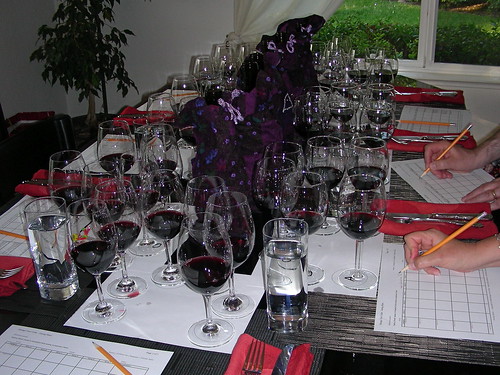
Our Wine Tasting Setup


The wines we tasted:
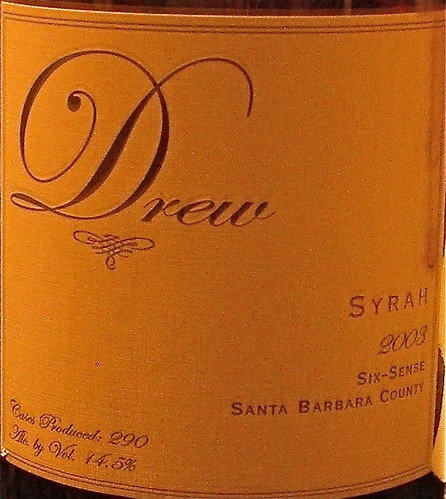
• 2003 Drew Syrah Six Sense Santa Barbara County: Drew Wines focuses solely on vineyard and appellation specific Pinot Noir and Syrah. The Six Sense Syrah is a blend of 100% Syrah from six different vineyards located within Santa Barbara County, and from six different grape clones. The different components of the wine were barreled separately and aged for eleven months, in a combination of French and American oak barrels, 1/3 new, 2/3 neutral. Our notes: nose of sweet cherry nectar, ripe and smooth on the palate, spices and herbs on the finish. Well balanced, food friendly. Finished in second position.

• 2005 Ridge Syrah Lytton West: Ridge's Lytton West Vineyard is located in the hills separating the Dry Creek and Alexander Valleys in Sonoma County. The wine is 94% Syrah cofermented with 6% Viognier. According to the winery's website, “Viognier has a beautiful pungency of apricot, peach, and white flower which helps lift the total aroma of syrah which tends to be dark and gamey.” Our notes: nose of cooked fruit with notes of cinnamon and blueberry. Rich, smooth on the palate with flavors of creamy custard. Lengthy finish. Finished in first position.
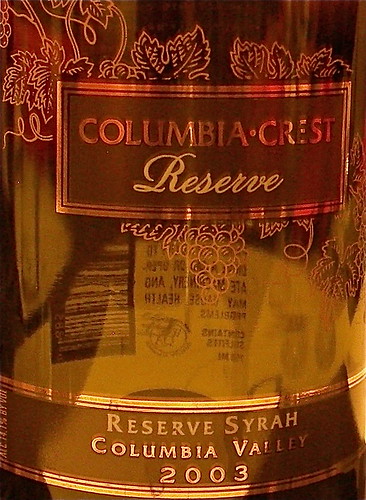
• 2003 Columbia Crest Reserve Syrah Columbia Valley: founded over 20 years ago, Columbia Crest is one of Washington State's main wine producers. The 2003 Reserve Syrah was co-fermented with 2% of whole berry Viognier whith fruits coming from two vineyard sites—one for Syrah and one for Viognier—in the Horse Heaven Hills appellation. Our notes: fruit forward nose with notes of green pepper and cocoa. On the palate, medium bodied, high in alcohol with a spicy, earthy finish. Finished in third position.

• 2006 Cornas Granit 30 Domaine Vincent Paris: Vincent Paris, co-president of the Cornas appellation, owns 6 hectares of vineyards located along the southeast facing Cornas slope as well as in the nearby St. Joseph appellation. He makes two Cornas designations, the Granit 30 and Granit 60, that differ in terms of soil, age of the vines, and location in the slope. The Granit 30 comes from younger vines at a lower grade slope and is made in a more “consumer friendly” style. Our notes: barnyard aromas on the nose, tannic, acidic on the palate, not consumer friendly. Finished last.
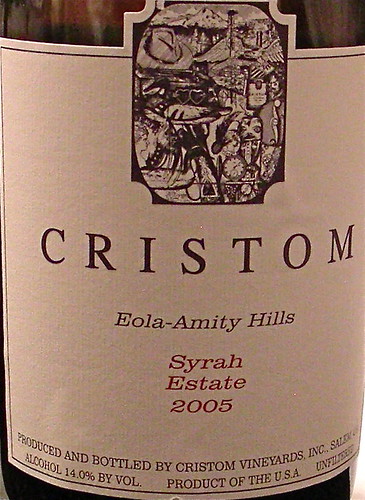
• 2005 Cristom Estate Syrah: Cristom Vineyards cultivates eight distinct vineyards in the Eola Hills area of Oregon's Willamette Valley. Plantings include Pinot Noir, Chardonnay, Pinot Gris, Viognier and Syrah. The vineyards are dry farmed with low yield. Our notes: notes of chemicals on the nose, tight, tannic, acidic on the palate. Finished in fifth position.
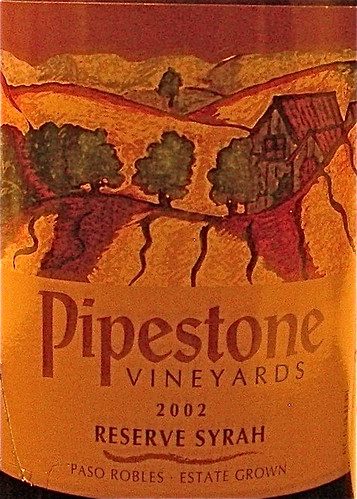
• 2002 Pipestone Reserve Syrah Paso Robles: Pipestone Vineyards is a small family winery located in the Paso Robles appellation. It is dedicated to sustainable farming and producing handmade Estate Grown Rhône-style wines from Syrah, Grenache, Mourvèdre, and Viognier and a dry-farmed Zinfandel. The Estate Syrah is grown on a south-facing hillside in the estate vineyard. Hand-harvested, it was aged in French and American oak barrels for 24 months. Our notes: dusty nose of caramel and cocoa. On the palate, high in alcohol, dry, tannic, not so well balanced but drinkable. Finished fourth.

Previous blind wine tastings:
•  Blind Tasting of Cabernet Blends from Washington State
•  Blind Tasting of Pinot Noir from Los Carneros and Anderson Valley
•  Blind Tasting of Grenache-based Wines

Technorati tags:

Tuesday, September 08, 2009

Pairing wine and cheese

Pairing wine with cheese was the theme of our last wine club event before the summer. Choosing the type of wine that works well with cheese is always a challenge although some pairings are natural: Sancerre with Goat Cheese or Port with Stilton. On the other hand, try a young Cabernet with Camembert, that's pretty tough! Try it with aged hard cheese instead.

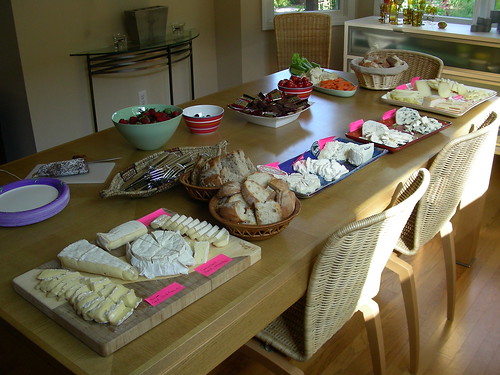
That evening, we tasted cheese from four different kinds (goat cheese, soft cheese, hard cheese, and blue cheese) with three whites, three reds, and one dessert wine, and found some really good matches.


Our cheese selection


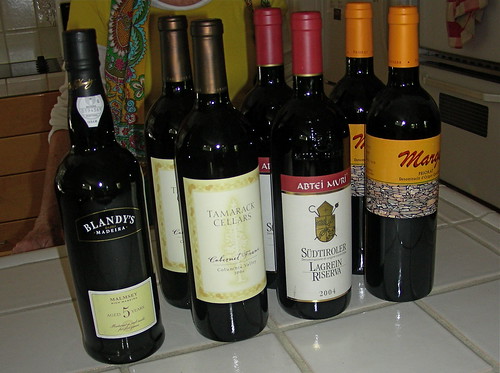
Our wine selection


Here are the wines that we tasted:

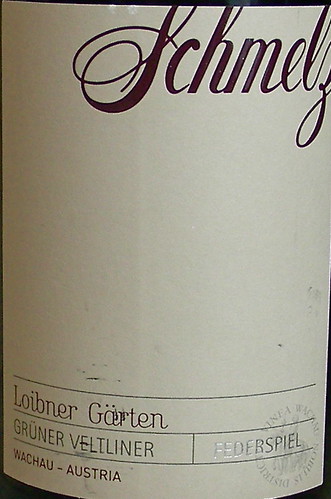
• 2007 Schmelz Grüner Veltliner Loibner-Gärten Federspiel: Grüner Veltliner is a white grape variety grown primarily in Austria (it accounts for 36% of all Austrian vineyards) and in the Czech Republic. Weingut Schmelz is located in the Wachau appellation, which is Austria's most famous wine region. It's a narrow valley that runs along the Danube river where vines grow on steep terraces carved into the slopes. The Schmelz family has been making wine for five generations. Manually harvested, the grapes are fermented in stainless steel tanks. My notes: pale yellow color, citrus on the nose, dry and mineral on the palate, long finish. A perfect accompaniment to our Redwood Hill Goat Cheese.

• 2007 Neudorf Sauvignon Blanc Nelson: Nelson is located on the northern end of New Zealand's south island. Cool growing conditions are well suited to Chardonnay, Sauvignon Blanc, Riesling and Pinot Noir. Neudorf Vineyards is a small family owned winery producing Chardonnay, Sauvignon Blanc, Riesling, Pinot Gris, and Pinot Noir. My notes: light color, aromatic nose, notes of grapefruit and tropical fruit, fresh finish. A good match with the goat cheese.

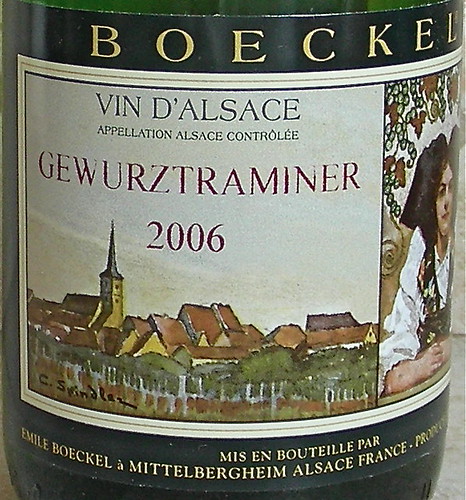
• 2006 Emile Boeckel Gewürztraminer: Gewürztraminer is the second most planted grape variety in Alsace where it comes in different styles from the very dry to the very sweet. Domaine Emile Boeckel has been making wine in the village of Mittelbergheim in Alsace since 1853. My notes: golden color, expressive nose of rose petals and caramel, off-dry on the palate. Try to find a strong tasting cheese like Münster to go with it.

• 2004 Muri-Gries Abtei Muri Lagrein Riserva: Lagrein is a red grape variety native to the Alto Adige (or Süd Tyrol) region in Northern Italy. It is related to Syrah and Pinot Noir. Cantina Convento Muri-Gries is an ancient Benedictine monastery in Alto Adige. It was built in the late eleventh century originally as a fortress. My notes: deep red color, aromas of black cherry on the nose, earthy on the palate with notes of coffee on the finish. Lagrein is also the name of a cheese made from cow's milk from the same region. If you're lucky to find it, try it with the wine.

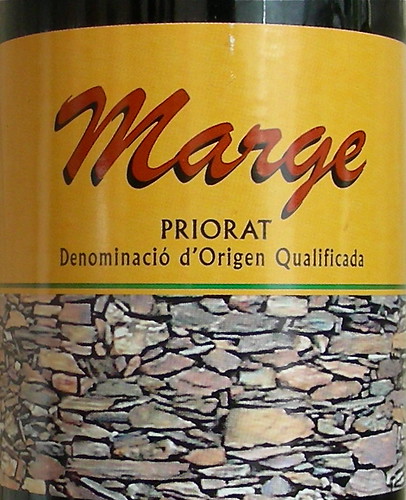
• 2006 Celler de l'Encastell Marge Priorat: Priorat lies in a remote mountainous area, 80 miles southwest of Barcelona, in Catalonia. Vineyards are planted on steep terraces at altitudes of between 100m and 700m above sea level. Summers are hot and dry, while winters are cold. The soil, made of reddish and black slate with small particles of mica (called llicorella in Catalan), reflects and conserves the heat. The main grape variety is Garnacha or Grenache, followed by Cariñena (Carignan), Cabernet Sauvignon, Merlot, and Syrah. Founded in 1999, Celler de l'Encastell is a small family-run winery that makes two wines. Roquers de Porrera is a blend of 40% Cariñena, 40% Garnacha, 20% Merlot and Syrah, aged in French oak for 16 months. Marge is a blend of 60% Garnacha, and 40% Cabernet Sauvignon, Merlot and Syrah, aged in French and American oak for eight months. My notes: dark color, spicy nose, opulent on the palate, try it with aged Manchego.

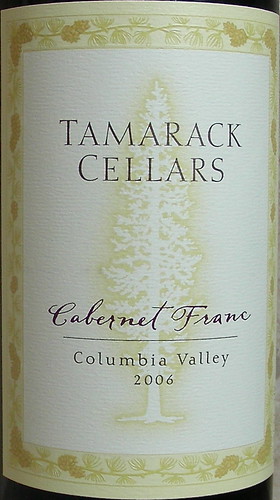
• 2006 Tamarack Cellars Cabernet Franc Columbia Valley: believed to be one of the genetic parents of Cabernet Sauvignon, Cabernet Franc is grown primarily to be blended with Cabernet Sauvignon and Merlot and is rarely vinified alone, except in the Loire Valley. With long summers and cool autumns, Washington State offers good growing conditions for Cabernet Franc and the varietal is today the fourth most widely planted grape in the state behind Cabernet Sauvignon, Merlot & Syrah. Founded in 1998, Tamarack Cellars hand-crafts small-lot wines from the Walla Walla, Yakima and Columbia Valleys. My notes: dark garnet color, black fruit aromas on the nose with notes of oak and tobacco, rich mouthfeel leaving hints of cocoa on the finish. A big favorite of the evening, it worked well with the parmesan, and the chocolate!

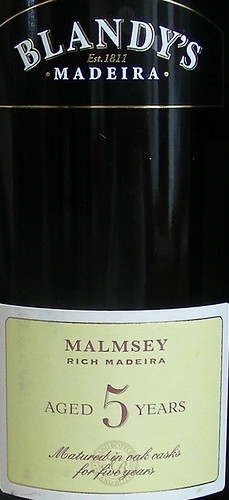
• Blandy's Malmsey 5 Year Old Madeira: Madeira is an Atlantic island belonging to Portugal and also a fortified wine that is probably the most resilient wine in the world. Winemaking in Madeira dates back to the Exploration Age. Madeira was the port of call for ships heading to Africa, Asia, and South America. At the time, in order to prevent wine deterioration, neutral alcohol was added to the wine. It was soon found out that wine exposed to heat and rolling movements on the ship somehow tasted better. Today, Madeira is known for its unique winemaking process meant to duplicate the effect of a long sea voyage. This involves heating the wine up to temperatures as high as 60°C and exposing the wine to some levels of oxidation. Malmey, made from the Malvasia grape, is the sweetest style of Madeira that gains in richness and concentration with time in cask. My notes: dark amber color, nutty aromas with notes of dried fruits, sweet, but not cloying, with fresh acidity. An interesting match with the blue cheese and an excellent way to end the evening.


For our next meeting, we'll be tasting wines from the Santa Cruz Mountains wineries. Stay tuned!

Previous wine club tastings:
•  Tasting the wines of the Rhône Valley
•  Pinot Noir Tasting
•  Second "Guess The Wine" tasting party
Technorati tags:

Wednesday, May 06, 2009

Blind Tasting of Cabernet Blends from Washington State

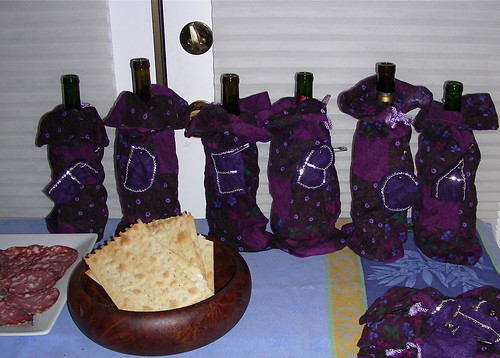
Earlier this year, our wine tasting group met again, this time for a blind tasting of Cabernet blends from Washington state. Each guest brought a mystery bottle that was quickly covered by one of our homemade purple velvet bags with a random letter pinned to it. The guests had to also bring their own glasses to be placed in a semi-circle in front of them, one glass for each wine.


The bottles are ready to be tasted blind


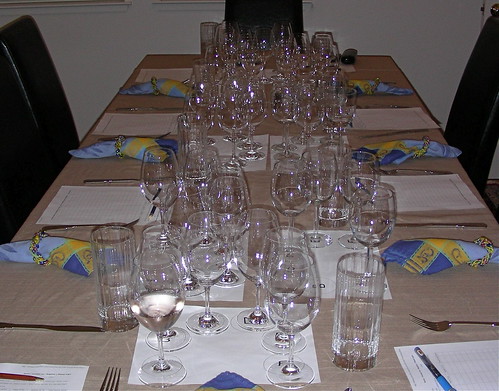
The tasting setup


Although about 50 years ago, there was no serious wine made in Washington State, it has quickly become the second largest fine-wine-producing state after California. Originally, Washington was mostly a white wine producing region, primarily using Chardonnay. Nowadays, it's more like 52 percent white to 48 percent red, the most widely planted grapes being Chardonnay, Cabernet Sauvignon, and Merlot.

Geographically, Washington State is located approximately on the same latitude (46ºN) as Bordeaux and offers a variety of very different climates. Western Washington, west of the Cascade Mountains, has a oceanic climate with relatively mild temperatures and wet, cloudy winters. Only 1% of the state's wine grapes are grown there. The other 99% of the wine grapes are grown east of the Cascades where the climate is semi-arid with long daylight hours during the growing season.

Here are the wines that we tasted:

2001 Seven Hills Reserve Cabernet Sauvignon Walla Walla Valley: founded in 1988, Seven Hills Winery is one of the region's oldest and most respected wineries, producing wines from the Columbia and Walla Walla valleys as well as Oregon's Willamette Valley. Walla Walla Valley is the most remote Washington wine region located at the Southeastern corner of the State. Although Walla Walla is a Native American name that means Place of Many Waters, the area has dry, arid conditions and cold winters. Our notes: nose of sweet fruit, herbs, and anise, medium-bodied with notes of oak, fresh, light finish. Ranked fifth place.

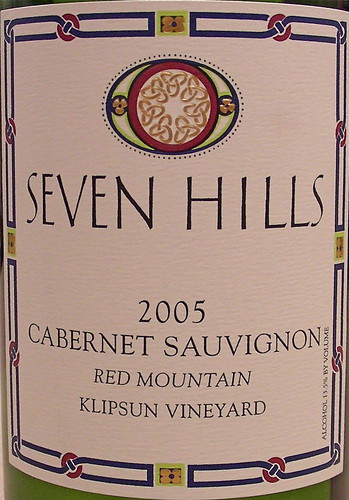
2005 Seven Hills Cabernet Sauvignon Klipsun Viyeyard Red Mountain: the wine comes from the 120-acre Klipsun Vineyard on the western slope of the Red Mountain appellation. Klipsun means sunset in the Chinook Indian language. The soil is shallow with sand and silt. Our notes: mint and eucalyptus on the nose, round and chewy on the palate, good flavors. Ranked third place.

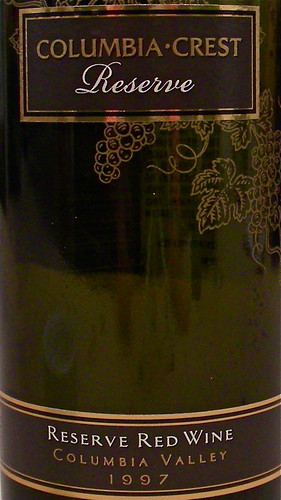
1997 Columbia Crest Reserve Red Wine Columbia Valley: founded in 1983, Columbia Crest has grown from a small winery in a relatively unknown wine region to one of the largest wineries in the United States. By 1990, wine critic Robert Parker had named Columbia Crest one of the 24 best value wineries. The wine is a blend of Cabernet Sauvignon (39%), Merlot (39%) and Cabernet Franc (22%) sourced from four Columbia Valley vineyards. Our notes: sweet red fruits on the nose, supple, tasty, meaty on the palate with aromas of raspberry liqueur, Bordeaux-like, food friendly. A big favorite, ranked first place.

2001 Kiona Reserve Cabernet Sauvignon Red Mountain: founded in 1972, Kiona Vineyards and Winery is a family-owned and operated estate that pioneered the development of the Red Mountain AVA. Red Mountain is part of the Yakima Valley AVA, which in turn is part of the larger Columbia Valley AVA. Kiona is a Yakima Indian name that means brown hills. Our notes: subtle nose, tobacco and chocolate on the nose, nutty and flavourful palate, medium finish, well balanced, opens up nicely in the glass. Ranked second place.
13.9%

2006 Isenhower Red Paintbrush Columbia Valley: founded in 1999, Isenhower Cellars is a boutique winery located south of Walla Walla. It produces wines using fruits coming from a variety of sources in the Columbia Valley. Their 2006 Red Paintbrush is a blend of 67% Cabernet Sauvignon, 17% Cabernet Franc, 11% Merlot, and 5% Petit Verdot. Our notes: fresh raspberry and cocoa on the nose, tight on the palate, too young, a bit harsh on the finish. Ranked sixth place.

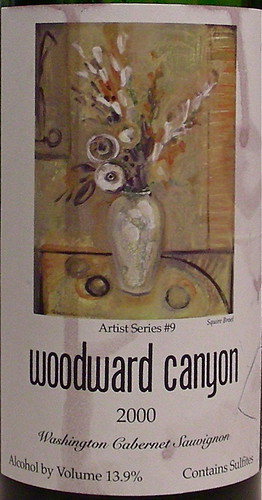
2000 Woodward Canyon Artist Series #9 Cabernet Sauvignon: Woodward Canyon Winery was one of the first two wineries (with Leonetti Cellars) to help put the Walla Walla Valley on the Washington wine map. The Artist Series started in 1992 to showcase Washington State Cabernet Sauvignon. The label changes every vintage with work from different local, Pacific Northwest artists. Our notes: chocolate and pepper on the nose, full bodied, tannic, good finish. Ranked fourth place.

Technorati tags:

Wednesday, June 13, 2007

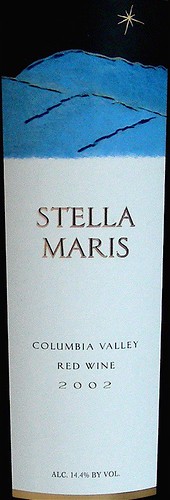
WBW #34: 2002 Stella Maris Red Columbia Valley

Oh my! The June edition of Wine Blogging Wednesday is today! This month, the world famous tasting event is hosted by the Wild Walla Walla Wine Woman and the theme is of course a Washington State Cabernet Sauvignon.

Therefore, for tonight's dinner, I chose a Cabernet blend from Northstar, a winery located in Walla Walla. “Walla Walla is culturally the anti-Napa — it's cozy and familiar — with an amazing camaraderie among the growers and winemakers.” says the winery website.

The 2002 Stella Maris Red Columbia Valley is a blend of 51% Cabernet Sauvignon, 44% Merlot, 5% Malbec, from selected vineyards in the Columbia Valley and Walla Walla Valley. “Stella Maris” means “Star of the Sea” in Latin and refers to the Virgin Mary. The wine is affectionately called “Stella” by the winemaking team and is considered the little sister to Northstar's flagship wine, the Columbia Valley Merlot. It has a dark red color and intense aromas of sweet fruit and leather on the nose. The palate is tannic but juicy with a long earthy and minty finish. Stella Maris, you're a real star!

Technorati tags::

Wednesday, May 23, 2007

Tonight, let's have a glass of 2003 Seven Hills Ciel du Cheval Red Mountain

I generally enjoy the red wines from Washington State. I like their distinctive style, rich although well balanced, and often less jammy and less alcoholic than their Californian counterparts.

So tonight, I am tasting the 2003 Seven Hills Ciel du Cheval Red Mountain. The Ciel du Cheval Vineyard is one of the most renowned vineyards of the Northwest. It is located east of the Cascade mountain range, in the Red Mountain AVA, Washington's smallest appellation. The place has an arid and hot desert climate with significant diurnal temperature variation. The soil is high in calcium, thus very alkaline, which makes it hard for the plants to extract nutrients and therefore keeps vigor down. Red Bordeaux and Rhone varieties are particularly well adapted to these growing conditions. The name Ciel du Cheval means Horse Heaven, a tribute to the nearby Horse Heaven Hills.

The wine is a blend of Merlot for softness, Cabernet Sauvignon for power and structure, and Cabernet Franc with a dash of Petit Verdot for aromatics. The color is dark red-purple. The nose is spicy and a touch heady. The palate is dense, mouthfilling with some good acidity. It is a promising young wine but this horse in heaven may need a few more years to be tamed! If you cannot wait, try it with a juicy ribeye steak.

Technorati tags: