Wednesday, February 01, 2012

A charming Swan from the Russian River Valley

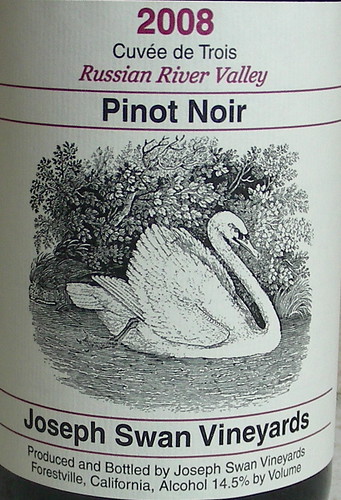
This was a low key, mid-week dinner at home and we were sipping our wine. “Wow, this wine is delicious!” my husband suddenly said. I showed him the bottle. It was a 2008 Joseph Swan Pinot Noir Cuvée de Trois Russian River Valley, a fairly-priced wine from Russian River Valley Pinot Noir pioneer Joseph Swan Vineyards.

Located in the Russian River Valley, Joseph Swan Vineyards was founded by Joseph Swan in 1989. He was a retired pilot with no formal viticulture education, but after taking many trips to France, he became known for introducing new methods of winemaking that seemed revolutionary at the time in the United States. These techniques included whole cluster fermentations, extended maceration for more color and depth, and fermenting without the addition of sulfur.

Joseph Swan's son-in-law Rod Berglund is now in charge of the winemaking. He introduced the “Cuvée de Trois” in 1999, a blend from three Russian River vineyards, each site contributing unique characteristics to the final cuvée.

The wine is a charmer. The nose is expressive with aromas of red cherry, spices, and earthy notes, and the palate has a silky, juicy texture, showing more finesse than power with a well-balanced complexity. Delicious indeed!

Technorati tags:

Tuesday, January 10, 2012

A wine made from the blood of the stones

That's the 2001 Vacqueyras Domaine Le Sang des Cailloux Cuvée de Lopy. The wine is from Vacqueyras, an appellation in the Southern Rhône next to Gigondas and to the east of Châteauneuf du Pape.

It is produced by Domaine Le Sang des Cailloux, which means Blood of the stones, a 17 hectare estate located on an arid plateau made of red clay and limestone layered by rounded stones — the famous galets roulés that characterize the terroir of Châteauneuf du Pape. On the plateau, the summers are dry and hot but can be cooled down by the strong Mistral wind that blows from the north down the Rhône Valley.

Although it has not been officially certified organic, the vineyard has been farming organically for years. The Cuvée de Lopy is 75% Grenache, 25% Syrah from 55 to 65 year-old vines. Lopy is the name of the farm where the owner, Serge Férigoule, was born. After being manually harvested, the grapes are fermented using indigenous yeasts and then aged in large 450-liter barrels. The wine is unfined and unfiltered.

The wine was dark, rich, dense and amazingly fresh at the same time thanks to its high acidity. It was also perfectly balanced leaving a layered finish of wild berries, spices, and licorice. It was aso the perfect wine for a chilly evening. Try it with a Provençal Daube and don't forget the orange peel, that's the dish's secret ingredient!

Technorati tags:

Tuesday, December 27, 2011

A festive dinner at Manresa

Just before the holidays, we went to Manresa in Los Gatos to celebrate my son's birthday. We took the seasonal tasting menu —highly recommended to us— that consists of 7 savory and 2 dessert courses and is the best showcase for the inventive cuisine of Chef David Kinch. It is also quite adventurous: only the ingredients are listed so you don't know ahead of time what each course would be like.

Chef David Kinch's cuisine speaks of who we are and where we are located and many products are produced at Love Apple Farms in the Santa Cruz Mountains. Owner and farmer Cynthia Sandberg uses biodynamic and organic principles to grow fruits, vegetables, herbs and edible flowers, and produce eggs, honey, and goat's milk. The Love Apple Farms produces were perfectly showcased by one of our favorite courses, “A walk through the vegetable garden”, a colorful alchemy of bitter leaves, sweet flowers, raw and cooked root vegetables with multiple dressings hidden under the leaves, some more citrusy, some more vinegary.


A walk through the vegetable garden


The next course reached even higher heights. Called “The Midwinter Tide Pool”, it was a bowl of rich broth that contained seaweed, clams, sea urchin, enoki mushrooms and the ultimate savory deliciousness, a thin slice of foie gras.


The Midwinter Tide Pool


I am not a dessert person but our second dessert was also one of my favorite. It was a mushroom ice cream with maple syrup, cinnamon chips and a small crispy churro. The dish was sweet and savory at the same time and full of umami flavors.


Mushroom ice cream with maple syrup, cinnamon chips and churro


The wine list has a nice focus on the Santa Cruz Mountains. We chose a 2006 Mount Eden Estate Bottled Pinot Noir from the nearby Mount Eden Vineyards. Located on a 2000 foot peak about 15 miles from the Pacific Ocean, the winery was founded in 1945 by pioneer winemaker Martin Ray who planted his first vineyard of Pinot Noir and Chardonnay there. Today, seven acres of the estate vineyard are planted with Pinot Noir. The wine is fermented using natural yeasts and matures for eighteen months in French oak barrels (75% new). The wine showed a medium red color with fragrant aromas of forest berries, spices and earth on the nose. On the palate it was all about elegance, medium-bodied with a smooth texture and a savory earthy finish that went wonderfully well with David Kinch's alchemy.

Technorati tags:

Monday, November 21, 2011

Invite Austria to your Thanksgiving table

Finding the perfect wine that can go with all the rich flavors found on the Thanksgiving menu, the turkey, the stuffing, the gravy, the cranberries, and the various side dishes, can be challenging. Nonetheless, I think that a wine that is bright and fruity, and not too tannic nor alcoholic, is always a great choice. So when I recently tasted the 2009 Juris St. Laurent Selection, I thought that this year, it was time to invite Austria to our Thanksgiving table.

Owned by the Stiegelmar family, Juris farms 17 hectares of vineyards in the Neusiedlersee wine region, half way between Vienna and Budapest. This is the warmest part of Austria with climatic conditions well suited to red varieties, which explains the winery's special focus on St Laurent and Pinot Noir wines.

The Stiegelmar family has been cultivating grapes in this area since the 16th century. One of the winery's underground cellars was built in 1756, Mozart's birth year. It was dug 52 meters long, 12 meters below the surface, and maintains a stable temperature of 10°C (50°F).

But over the past 10 years, Axel Stiegelmar and his father Georg have developed a modern winery. The transport of grapes, mash, must, and wine is done predominantly through gravity to avoid damage by careless transport. The storage building is Austria's first passive energy wine storage facility. The building, neither heated nor cooled by fossil or electric energy, has various temperature and humidity zones to provide optimal storage conditions for different wines at different stages of their production.

cellars
The underground cellars


St. Laurent is a red grape of mysterious origins. It is said to belong to the Pinot family, although its exact ancestry remains unclear. It is an early ripening grape variety, sensitive to frost, sunburn, and botrytis. The name comes from Saint Laurent's name day on August 10, which is when the veraison of the grape occurs.

If the wine had the bright acidity of a Pinot Noir, it was spicy like a Syrah. It showed a very dark color with aromas of black cherries, moka, and gamey notes. On the palate, it was quite smooth and tasty with maybe a hint of sweet chestnut on the finish.

turkey
Last year's turkey


Cross-posted from bluedanubewine.com/blog

Technorati tags:

Thursday, October 27, 2011

Special aviation wines for the Blue Angels Air Show

Earlier this month, we were invited to a wine tasting party while watching the Blue Angels Air Show, a spectacular aerial show and a tradition in San Francisco since 1981. We were asked to bring a bottle of wine that had some connection with aviation, which was a fun exercise because in addition to tasting the wines, this theme prompted discussion about how the wines were related to planes and pilots.


We started with the 2004 Goldeneye Pinot Noir Anderson Valley. That one was easy: everybody remembered how in Goldeneye, James Bond escapes Soviet guards with a free fall jump off a cliff into an unmanned plane, miraculously gaining control of it and avoiding a crash into the nearby mountain.

The Goldeneye Winery is owned by Duckhorn Vineyard and has been producing Pinot Noir from the Anderson Valley AVA since 1997. The wine is a blend of grapes from four estate vineyards, covering a wide range of microclimates with more than 20 distinctive clones. The wine had a big California style, lush on the palate with ripe berry flavors and hints of pumpkin pie spice on the finish.

Then we tasted the 2004 Château Malescot Saint-Exupéry, a Third Growth in the Margaux Appellation. Château Malescot Saint-Exupéry got its first name from Simon Malescot, King's Counsel to Louis XIV at the Parliament of Bordeaux, who bought the estate in 1697. Then later in 1827, it was acquired by Comte Jean-Baptiste Saint Exupéry, who renamed the property Malescot Saint-Exupéry. So what's the wine's connection with aviation? Antoine de Saint Exupéry, pioneer aviator and famous writer, was actually the grandson of Jean-Baptiste.

The wine is a blend of 50% Cabernet Sauvignon, 35% Merlot, 10% Cabernet Franc and 5% Petit Verdot. It had a dense, blackberry nose with some coffee notes, quite chewy on the palate with a well-balanced finish. A promising wine but much too young to be drunk now.

Our third wine was the 2005 Silverado Vineyards Cabernet Sauvignon Solo Stags Leap District. First, we thought of solo flight, but after some discussions, we found that Solo had even more connections to flying, including Han Solo, famous captain of the Millennium Falcon.

Silverado Vineyards was established in 1981 by the Miller family. They named the winery Silverado, after the abandoned mining camp in the Mayacamas Mountains, where Robert Louis Stevenson spent his honeymoon in the early summer of 1880.

The Solo Cabernet Sauvignon is made from 100% Cabernet grapes grown in the estate Stags Leap Vineyard, surrounding the winery. It was a powerful wine with aromas of blackberries and oak and a big finish.

We ended the tasting with a vertical tasting of ZD Reserve Cabernet Sauvignon: 2000, 2001, 2002, and 2003.


Nobody knew that ZD stands for the initials of the names of the founders Gino Zepponi and Norman deLeuze, two former aerospace engineers. It also stands for Zero Defects, a quality control program that originated in the aerospace industry.

The ZD Reserve Cabernet Sauvignon is a blend of several Napa Valley lots, with ZD's organically farmed Rutherford Estate used as the backbone. The 2000 was the first vintage to open up, with an expansive nose and ripe fruit aromas. The 2001 was tighter and more subdued at the beginning but it eventually surpassed the 2000 with aromas of blackberries, moka, and licorice, a firm, well-balanced backbone, and a full-flavored finish. It ended up being my favorite. The 2002 was not as good and a bit off balanced. The 2003 was young, bright, and fruity but without the complexity of the 2001.

And above our heads, the Blue Angels were flying.


Technorati tags:

Wednesday, October 12, 2011

Prohibition through Ken Burns' lens

Last week I watched Ken Burns' five-and-a-half-hour three-part documentary on Prohibition, the so-called “Noble Experiment” and one of the country's biggest civic failures.

I like Ken Burns' work, especially his Jazz series, and Prohibition didn't disappoint me. I already knew some of the causes that led to the passage of the 18th Amendment: the force of the Temperance Movement and how its leaders were also pushing for women's rights, how the passing of the income tax amendment made Prohibition fiscally feasible, and the strange alliance of militant suffragettes with white supremacists to ban alcohol use.

But there were some other facts that I was not aware of, like the vilification of German-Americans —which included most of the large brewery owners— when the US entered World War I. And I didn't realize that women, after lobbying so hard for prohibition, became so pivotal in the effort to repeal it.

Pauline Sabin, a wealthy heiress from a Republican family, initially supported prohibition, but as crime increased, her criticism of the 18th Amendment grew slowly. At some point, she realized that “In pre-prohibition days, mothers had little fear in regard to the saloon as far as their children were concerned. A saloon-keeper's license was revoked if he were caught selling liquor to minors. Today in any speakeasy in the United States you can find boys and girls in their teens drinking liquor, and this situation has become so acute that the mothers of the country feel something must be done to protect their children.”

She founded the Women's Organization for National Prohibition Reform in 1929. Four years later, the 18th Amendment, was repealed.

Technorati tags:

Tuesday, September 27, 2011

Pupusas from El Salvador and a good Pinot from the Santa Cruz Mountains

The other day, we were invited to a Pupusas party, one of the guests' mother being from El Salvador and a great cook. The pupusa is El Salvador's national dish, made of thick corn tortillas typically filled with cheese, pork, and beans and cooked on a griddle.


Freshly made and still hot from the skillet, it is really tasty but what to drink with it besides beer? Actually we found that Pinot Noir was a pretty good choice, especially if you avoided the extra spicy salsa.

We tasted the 2003 Muccigrosso Pinot Noir Santa Cruz Mountains from Muccigrosso Vineyards, a small family-run winery in Los Gatos, in the Santa Cruz Mountains.

The owners, Michael and Lynne Muccigrosso, planted their first vines in 1983 and bottled their first vintage in 2000. Now they produce 800 to 1000 cases per year of Pinot Noir, Zinfandel, and a Syrah-Sangiovese blend called Table Two. The 2003 Pinot Noir was crafted by Jacob Kauffman, a yound talented winemaker who had gained his experience at near-by David Bruce Winery but who sadly passed away 2 years ago.

The wine had a bright garnet color and perfumed nose of sweet berries and violets. On the palate, it was medium-bodied with a good structure, elegant with a good amount of earthiness on the finish. Quite comforting, like the pupusas.


Technorati tags: