Wednesday, June 18, 2008

Winemaking step #9: fining

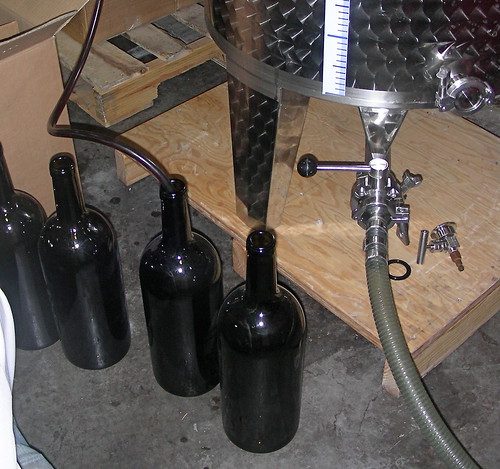
Earlier this week, we had another meeting with Crushpad chief winemaker Mike Zitzlaff. The objective was to determine the appropriate amount of egg white in order to remove the proper amount of bitter tannins in our wine. We had learned at our previous meeting that the albumin contained in the egg white was particularly effective at removing aggressive tannins without affecting the other desirable flavors of the wine.

This time, Michael had prepared three samples with three different dosages: the first one had 1 gram of egg white per 1 liter of wine, the next one 0.8 gram per 1 liter, and the last one 0.6 gram per 1 liter.

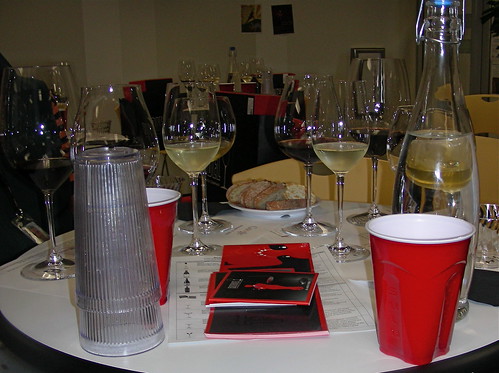
Tasting these samples was eye-opening: the first one seemed to have lost most of its body — too much egg white —, the third one had a harsh finish — not enough egg white —, and like Goldilocks finding Baby Bear's porridge, we found that the second one was just right.

Everybody was happy with the 0.8 dosage, which means that we could move forward with the fining. And then, the wine will be ready for the next and final stage: bottling!


Related posts:
•  Winemaking step #8: blending
•  Winemaking step #7: barrel tasting
•  Winemaking step #6: after the malolactic fermentation
•  Winemaking step #5: pressing the wine
•  Winemaking step #4: getting ready for the pressing
•  Winemaking step #3: monitoring the fermentation
•  Winemaking step #2: inoculation of the must
•  Crushing at Crushpad
•  2006 Cabernet Sauvignon Ink Grade Vineyard Howell Mountain

Technorati tags:

Labels: , , ,

Wednesday, May 28, 2008

Winemaking step #8: blending

After being in barrel for almost 18 months, it is almost time for our 2006 Crushpad Cabernet Sauvignon Ink Grade Vineyard to be bottled. But first, we had to decide on the final steps: blending and fining.


Our Cabernet Sauvignon in its new oak barrel


So last week, we met with Crushpad's Chief Winemaker Mike Zitzlaff who had prepared for us some blending wine samples: a 2006 Cabernet Franc, a 2007 Merlot, and a 2007 Cabernet Sauvignon.


Wine samples for the blending


First we tasted our wine: dark, intense nose of black fruit, thick, with a strong oaky finish. Mike explained that at this point the wine was unbalanced and had too much oak for the amount of fruit — maybe it stayed too long in its new oak barrel. Therefore, the purpose of blending would be to add more fruit to the wine.

Then, we tasted the other wine samples. The Merlot was soft and fruity with blueberry flavors, the Cabernet Sauvignon was ultra ripe and pruny, and the Cabernet Franc was somewhat herbal. We all agreed that the merlot was the best.


Assembling different blends


We started with a 5% Merlot blend: the Merlot had brought its blueberry flavors to the Cabernet but the oak was still very present. The 10% Merlot blend was very fruity but lacked backbone. The 7.5% was a good compromise: good fruit and nice backbone although the finish was still oaky. “Don't worry,&rdquo said Mike, “We are going to use egg whites and this will soften that harsh finish&rdquo.

Egg whites are a traditional fining agent used to reduce the amount of harsh tannin and soften the texture of red wines. The albumin contained in the egg white absorbs tannin particles, thus reducing astingency in wine.

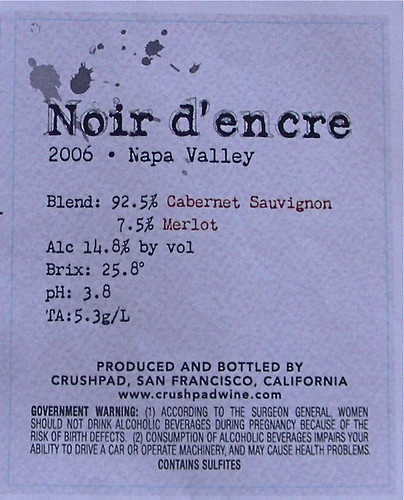
Our wine is now in a tank, blended with 7.5% Merlot. We'll come back next week to do the fining. In the meantime, we're working on the label and trying to find a name. What about Noir d'Encre?

Related posts:
•  Winemaking step #7: barrel tasting
•  Winemaking step #6: after the malolactic fermentation
•  Winemaking step #5: pressing the wine
•  Winemaking step #4: getting ready for the pressing
•  Winemaking step #3: monitoring the fermentation
•  Winemaking step #2: inoculation of the must
•  Crushing at Crushpad
•  2006 Cabernet Sauvignon Ink Grade Vineyard Howell Mountain

Technorati tags:

Labels: , , ,

Tuesday, April 29, 2008

The 2004 Sequia Grove Cabernet Sauvignon Napa Valley

This bottle was sent to me by the Kobrand Corporation, the wine and spirit importer and distributor. When I received it, I became curious about the wine as I realized that I had never visited the Sequoia Grove winery, although it is right on Highway 29, just 1 mile north of Rutherford.

Family-founded in 1980 on the site of an 1850 farmhouse, Sequoia Grove is named for the grove of giant redwood trees that surround the winery. Today, this boutique winery produces small quantities of premium wines and specializes in Cabernet Sauvignon.

Michael Trujillo is the winery’s longtime winemaker. “In my winemaking I strive for balance and varietal character to come through,” says Michael of his winemaking philosophy on the winery website. “I don’t get carried away with the big, high-alcohol wine trend that influences much of the industry today. I strive for richness and balance from start to finish. This is the way I make wine.”

Under new ownership, the winery has recently upgraded its winemaking facility with state-of-the-art fermenters and processing equipment. A completely subterranean cellar —the first in the Valley— maintains a year-round temperature of 58°F. The fruit is sourced from the winery's estate vineyard in Rutherford as well as from renowned Napa growers such as Gary Morisoli, Andy Beckstoffer, and others.

The grapes for the 2004 Sequoia Grove Cabernet Sauvignon Napa Valley were sourced from Rutherford (50%), Oakville (30%), Atlas Peak (15%), and Napa (5%). The wine is pure Cabernet Sauvignon, aged in American oak (38% new) for 18 months. It has a deep inky color and an engaging nose of black fruit and licorice. On the palate, it is concentrated without being jammy, with substantial tannins, some good acidity, and notes of vanilla and mint on the finish. Overall, I find it rather well balanced for such a young wine, although I would cellar it for at least 5 more years, but that's my personal taste. In the meantime, decant it for at least 1 hour and enjoy it with grilled ribeye steaks with Mediterranean rub and oven wedge fries.

Technorati tags:

Labels: , ,

Thursday, September 20, 2007

Beaulieu Vineyards Georges de la Tour Private Reserve Cabernet Vertical Tasting by James Strohecker

My friend James Strohecker was very lucky to attend a vertical tasting of Beaulieu Vineyards Georges de la Tour Private Reserve Cabernets. The event was organized by wine collector George Kautzman on September 6, 2007. Kindly enough, James is now sharing his tasting notes with us:

Overview

The Beaulieu Vineyards Georges De La Tour Private Reserve Cabernet tasting was a special, once-in-a-lifetime chance to sample some of the great Napa Cabernets from some great years: 1968-1976. Over the years, noted collector, George Kautzman, painstakingly acquired the Georges De La Tour Private Reserve Cabernets for the sole purpose of one day hosting vertical tastings of the wines.

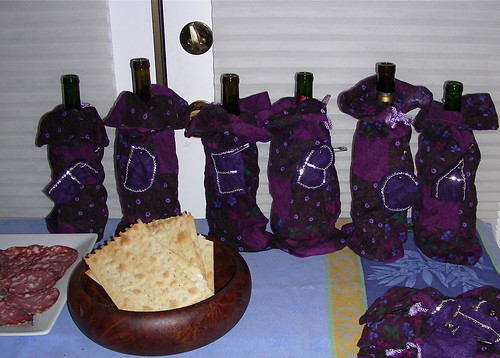
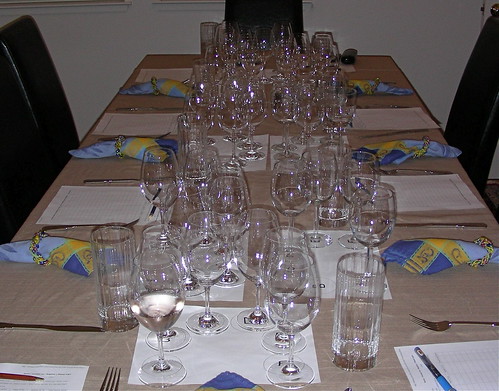
The Georges De La Tour Private Reserve Cabernets were all 750 ml with generally high shoulder fills, and were pre-decanted between 5:15 p.m. and 6:15 p.m. prior to the 7:45 p.m. tasting. The wines were then blind tasted by the 11-person group, after they'd been bagged and offered to the tasters in flights of three, beginning with the youngest three wines, to the oldest three wines.

All of the Georges De La Tour Private Reserve Cabernets were purchased around the release date (generally five years after the vintage year) and original purchase price is provided as available (some bottles actually had the price tags still on them).

With regard to the (famous) 1968 vintage, the wine we tasted came from the last bottle of the second case of wine that George Kautzman had ever bought (his first case being a case of the Georges De La Tour Private Reserve Cabernet 1967 vintage). I think most of us expected this wine to knock us out of our seats and/or blow all the other vintages out of the water. The truth is, as you can read below, it didn't stand out as the highest-rated Georges De La Tour Private Reserve Cabernet of the evening.

In all, however, the majority of the wines from this era were still packed with Napa Cabernet clout; they opened up, and in some cases were remarkably edgy — but never flabby. This was simply a tremendous tasting, offered by a stellar host and collector, Mr. Kautzman.


General Notes

First flight: Great start; the 1976 vintage clearly stood out. These wines were an example of the fine Napa Cabernets that were produced by famed winemaker, Tom Selfridge.

Second flight: Only after we'd sampled the second flight, did George Kautzman read from the "White Book of California Wines", the bible on wine during that era. The 1972 Georges De La Tour Private Reserve Cabernet received a score of 11 out of 20. "The harvest was in rain and mud, with people gathering grape clusters in ankle-deep water ..." The 1972 Georges De La Tour Private Reserve Cabernet received a score of 16 out of 20.

Third flight: the best of the evening The surprise was that the 1968 Cab didn't stand out as the knock-down favorite. Feedback was varied. However, the 1969 vintage was vivid and solid; an unrecognized year with a tremendous output (from Beaulieu). Apparently, according to George Kautzman, his is not the first time that this Georges De La Tour Private Reserve Cabernet vintage has shown so well. It's been consistently great in tastings over the years.


WineTasting Notes
Roederer Estate Sparkling Wine NVClean, dry, refreshing — with a perky finish on the palate. Azalea blossoms and rice nose. Opened up a bit — with more flowers and a finer finish.
Grgich Hills 1978 Napa Valley ChardonnayNice, with residual fruit and pear blossom nose. Good color, with a polished finish.
Kenwood 1979 Deltane Ranch Sonoma Valley ChardonnayVery apple cider nose with a light, caramel finish. Color had changed to a cream soda look; nutty and Sauternes-like flavors on the palate.
Georges De La Tour Private Reserve Cabernets(in order of flight tasting)
1974 VintageFull nose; completed; Man, this is polished; pushing to perfection; "medicinal nose." 4 votes for best. ($16.99 original price)
1975 VintageLatent palate finish; "edgy and unbalanced," a little barnyard with some chocolate, less finished or polished. A second (delayed) tasting of this brought this reaction from me: "A lot of character." ($12.95 original price)
1976 VintageThis really sings; younger, with more bounce; Ummmm!; nice, nice finish. "Fresh fruit, nice and balanced." ($16.99 original price)
1971 VintageWow, Surprising finish; "Only 1/3 the menthol as the 1973."
1972 VintagePolished; full; driven. Berry, with a bouncy finish and a smooth nose. Some choco-berry hanging in the palate.
1973 VintageRich; classic; slight menthol nose.
1968 VintageChocolate and Napa soil; tobacco and spice. "Trunk of the car wine!" Very firm and diverse; food friendly. Leftover "muscle memory" from a great year. But it's the right time to consume this wine — it's not going to get any better.
1969 VintagePlush. Awesome. Complete. Holding steady & expanding into berry land. Surprisingly excellent.
1970 VintageVery, very good; this is an epitome of the Cabernet; cigar box nose; fruit intact; a lot of open-field room to move. The favorite of the tasters for the evening

James Strohecker


Technorati tags::

Labels: , , ,