Tuesday, October 03, 2006

Crushing at Crushpad

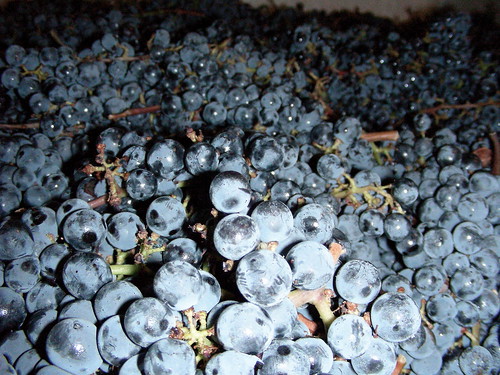
I was at Crushpad this morning because our Ink Grade Vineyard lot had been harvested yesterday and I wanted to participate in the destemming/crushing process. Of course, the first thing I did when I arrived at Crushpad was tasting the fruit. The berries were delicious, very sweet and flavorful. I also noticed how carefully hand-picked the grapes had been. The clusters were very clean and uniformly ripe with very few green or sunburned and shriveled berries. According to the final harvest data provided by Crushpad, the grapes had been picked at Brix 25.5, pH 3.39, and TA 7.5 g/l.

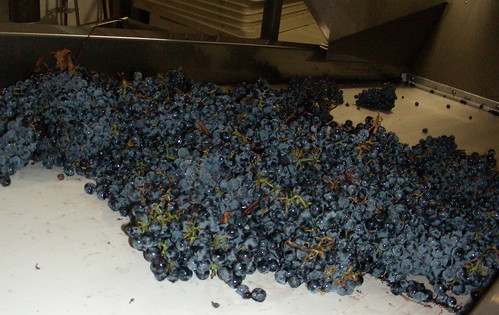
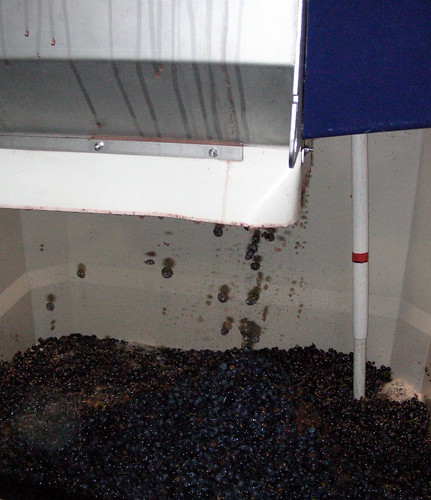
The destemmer/crusher is a machine that gently separates the berries from the stems to avoid bitter tannins, and then slightly crushes them. But before being fed through the destemmer/crusher machine, the grapes go on a sorting conveyor where they are carefully inspected and where leaves and bad berries can be removed.


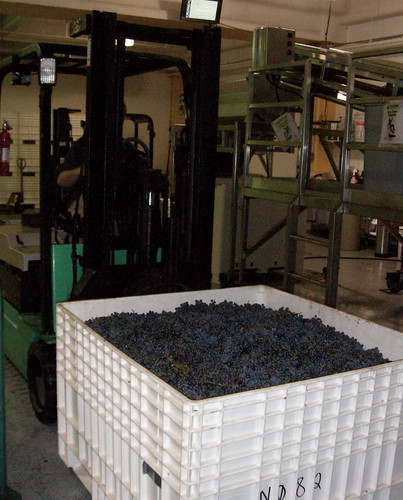
Our fruit is brought over to be destemmed/crushed


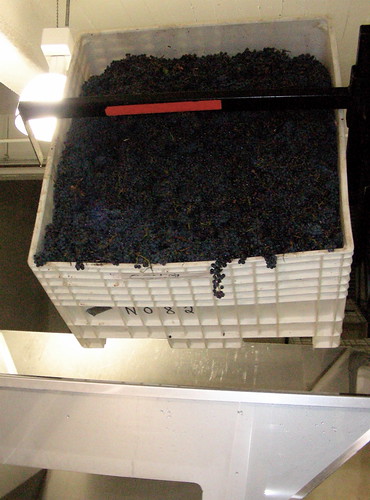
The grapes are dumped into the destemmer/crusher machine


On the sorting conveyor


The destemmed berries


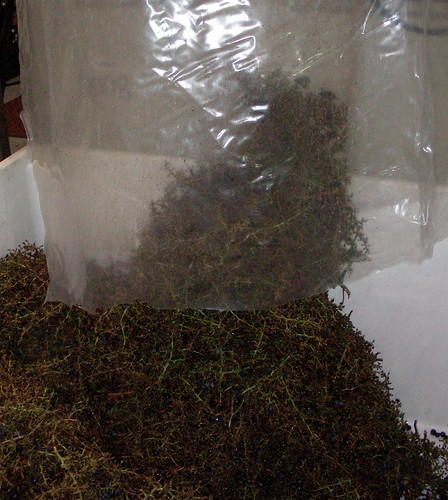
The leftover stems are falling out of the destemmer/crusher machine


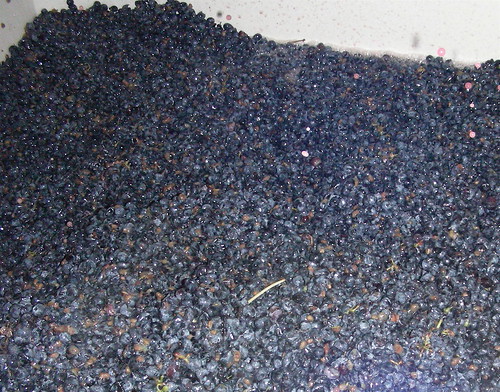
The final mix of juice, pulp and seeds called the must


After being crushed, the must, which is the final mix of juice, pulp and seeds, is ready to undergo a cold maceration. Cold maceration is a relatively new technique and a way to increase skin contact and extract color and phenolics. The grapes are thus chilled to 14ºC/60ºF for a couple of days in order to inhibit fermentation.

Now, after cold soaking, the next step will be to come back to Crushpad to inoculate our must with our chosen yeast, the BDX - Bordeaux Red.

Technorati tags:

Friday, September 29, 2006

Mediterranean meze and Greek wine

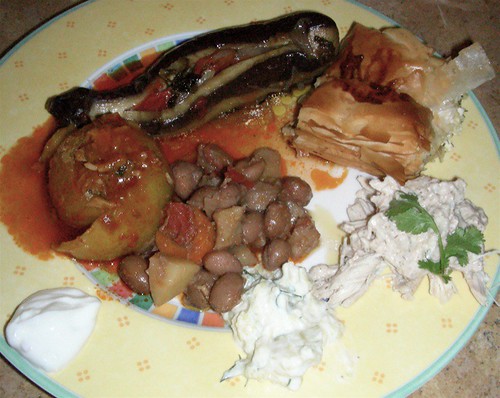
The other day, one of my friends from Turkey prepared a variety of meze dishes for lunch. Like the Spanish tapas, meze (or Mezédes in Greece) are small plates that are served in Turkey to accompany wine or more likely raki, the anise-flavored national drink. I was in charge of bringing the wine but I could not find any from Turkey. Instead, I chose a couple of wines from Greece, a white and a red, both from the Peloponnese.

The Peloponnese has a long tradition of winemaking. In the ancient times, Homer called it Ampeloessa, which means of vine leaves. Many indigenous grapes grow in the region, including the white varieties, Roditis, Sklava, Moschofilero and the red Agiorgítko. International varieties such as Chardonnay, Viognier, Cabernet Sauvignon, and Merlot are also cultivated and increasingly popular among winemakers that want to win entry into the foreign markets.

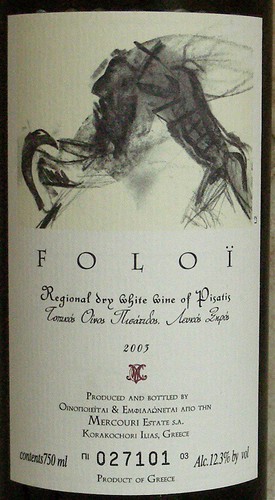
Our first wine was the 2003 Mercouri Foloi Roditis, “a fine, dry wine made from the Roditis variety grown at altitude on the plateau of Foloi, Ilias, in West Peloponnese, Greece — an area famous in Greek mythology for its aromatic wines.”, as it is described in the back label.

Roditis is a white variety that mainly grows in Central Greece and in the Peloponnese. The finest Roditis wines are produced from low-yielding, high elevation vineyards with a north-facing exposure. The wine had a light golden color and a nose of lime and grapefruit. The palate was crisp and well rounded with a refreshing finish of herbs and light spices. I really enjoyed the wine with the Imam Bayildi dish (The Imam Fainted), a dish of eggplants stuffed with onions, garlic, and tomatoes, simmered in olive oil.

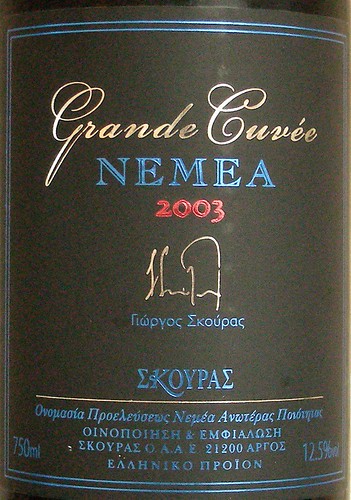
Our red wine was the 2003 Skouras Grande Cuvée from the Neméa appellation. Neméa is now considered by some to be Greece's most important appellation. It produces deeply colored and complex red wines exclusively from the Agiorgítko grape. The wine had a dark purple color and a peppery nose of blackberry and blackcurrant. The palate was medium-bodied with a well balanced acidity and notes of mint on the finish. The wine was a great accompaniment to Kabak Dolmasi, a tasty dish of zucchini stuffed with ground beef, rice, onion and spices, and served with a yogurt, dill, and garlic sauce.


Technorati tags:

Tuesday, September 26, 2006

Lucia Pinot Noir: sorry but not my cup of tea

Choosing a wine in a restaurant that is good and affordable at the same time is becoming, I think, more and more challenging. The other day, I was struggling to find a reasonably priced Pinot Noir and I asked the waiter about a wine that had a Sleepy Hollow Vineyard designation and sounded interesting. He seemed to ignore my question and came back with what I guess is one of the restaurant's best selling wines, a Pinot Noir from Lucia Vineyards.

The Lucia Vineyards winery is owned by the Pisoni family and produces wines from the renowned Garys' and Pisoni Vineyards in the Santa Lucia Highlands. The wine that the waiter poured had a dark color and a nose of vanilla and black cherry. The palate was very rich and unctuous with toasted oak and more vanilla flavors on the finish. I couldn't really say that the wine was bad although I found it overpowering but my friends were all happy with the waiter's choice and we kept the wine. However, was this wine the Pinot that I was looking for? Certainly not.

Technorati tags:

Friday, September 22, 2006

Sad that summer is over? Drink a Corsican wine

Have you ever been to Corsica? For me, this rugged and mountainous Mediterranean island is one of the most beautiful places on earth. As a kid, I spent a few wonderful summer vacations in Corsica, although I remember that getting there was far from easy. I haven't forgotten the crowded and uncomfortable ferry that we used to take to cross the Mediterranean sea from Nice to Bastia. My sister and I were always seasick but there was no room for us to lay down. Fortunately, on our way to our vacation place, we could quickly forget our miseries; there was so much to see: dense forests of chestnut and cork oak, wild boars running freely on the twisty mountain roads, pristine white-sanded beaches. And I also vividly remember this heady scents of myrtle, cistus, and heather that emanated from the sun-drenched maquis.


Palombaggia beach


Not far from Bastia, Patrimonio is one of Corsica's best wine region. On chalky soil mixed with clay, the vineyard has an exceptional western exposure facing the sea. Surrounding mountains protect the vines from the strong winds coming from the Rhône Valley. The deeply colored Niellucciuniellu means dark in Corsican — grows particularly well in the area and in Patrimonio, it must account for 95% of red wine. The grape is actually identical to the Tuscan Sangiovese and was most likely imported by Genoese during their rule of the island between the mid 15th century and the late 18th century.

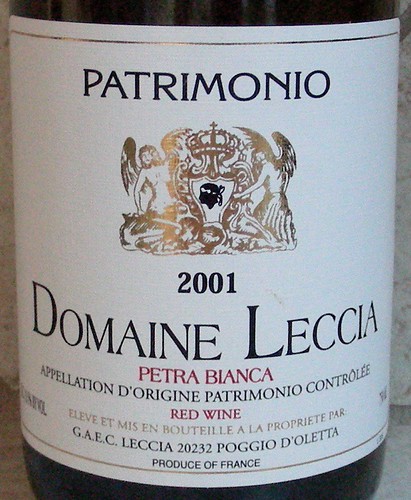
The 2001 Domaine Leccia Patrimonio Petra Bianca is one of the few Corsican wines that can be found in the United States. It is a Kermit Lynch import that I bought last year at his Berkeley store. It is produced by the Domaine Leccia, a family-owned estate established in 1850. The domaine has a 54 acre vineyard located just a mile away from the sea and planted with traditional varieties such as Niellucciu, Grenache, Malvoisia, and Muscat. It is farmed with no pesticide and the harvest is done manually. Petra Bianca (white stone) is the domaine's special cuvée, made from lots that are particularly rich in limestone and schist.

The wine had a dark, brick/brown color. The nose exhibited aromas of sweet blackberries and spices. On the palate, it was full-bodied and well balanced, leaving an aftertaste of bittersweet chocolate. There were also some herbal notes that reminded me of the myrtle berry liqueur, a Corsican specialty that my parents bought one day as a souvenir and that we used to top our crepes with.

Technorati tags:

Monday, September 18, 2006

Margaux en danger!

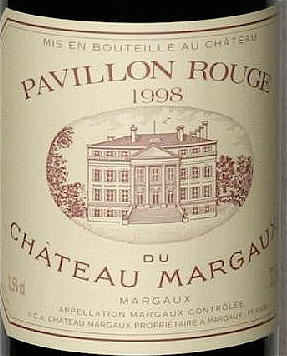
During the visit of my parents in law this summer, I decided to open in their honor a special bottle for dinner, a 1998 Pavillon Rouge du Château Margaux. This brought my father in law to tell us one of the hot stories in France at the time: the Bordeaux bypass project that could destroy some valuable vineyards in the renowned Margaux appellation.

The project that made many Bordeaux producers take up arms this summer is a plan to build a motorway that will bypass the congested town of Bordeaux and connect Spain with Northern Europe. The problem is that some of the proposed routes run through the vineyards of Margaux, including one route that could completely wipe out the vineyard of Château Cantemerle. More than 70 chateaux, including Château Margaux, signed an open letter to the local prefecture. Moreover, the representatives of the appellation created a dedicated website and blog — www.margaux-danger.com — to fight the proposal.

The latest news is that the government is trying to reach a compromise with the vintners and has published a revised plan that should not impact any vineyard. But opponents of the project are still worried about lead related pollution and damage to the terroir.

As we were discussing this, we were savoring the wine. It was dark in color, concentrated on the palate and, at the beginning, still tight and closed, so I decanted it. But as the wine opened up in the glass, it started to reveal its full personality, a perfumed nose of black fruits, a delectable, full-bodied palate with well-balanced tannins, and a finish that was long and classy — undoubtedly Margaux.

Technorati tags:

Wednesday, September 13, 2006

WBW #25: A Sparkling Blogging Wednesday

The 25th edition of Wine Blogging Wednesday is all bubbly thanks to Sam at Becks and Posh, our host this month. She wanted us to taste a sparkling wine coming only from the Champagne region.

If you're a Champagne fan, I highly recommend the extensive K&L Wine Merchants Champagne selection. K&L Champagne Buyer Gary Westby direct-imports fantastic wines from small grower producers. Grower producers farm their own vineyard and make their own Champagne, therefore produce wines that have distinctive personalities, expressing the vineyard they come from and the unique style of the winemaker.

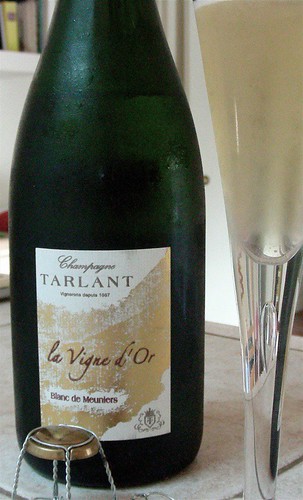
One of my favorite Champagnes from K&L is the Champagne Leclerc Briant Brut Premier Cru Clos des Champions, a single vineyard wine at an amazing price of $29.99. But today, I wanted to try something different that Gary had also recommended: a Blanc de Meuniers from Tarlant, a Champagne house owned by the Tarlant family since 1687.

The wine of Champagne is generally a blend of Pinot Noir, Chardonnay and Pinot Meunier. Pinot Noir accounts for nearly 40% of the plantings in Champagne and is often the backbone of the blend. 26% of the vineyard is planted with Chardonnay, which brings finesse and elegance, and 35% with Pinot Meunier, which provides acidity and fruitiness.

The Champagne Tarlant Extra Brut Blanc de Meuniers Cuvée La Vigne d'Or is an unusual wine made entirely from Pinot Meunier. It comes from a single vineyard in Tarlant's home town of Oeuilly with vines averaging 51 years of age. The wine had a straw golden color and a yeasty nose showing apple cider flavors. On the palate, it was dry, vivacious, but also slightly creamy, leaving a distinctive pear à l'eau de vie aftertaste.

We enjoyed our Champagne with a Grilled Tuna Basquaise, a dish that calls for a light and fruity wine. This was a joyful and sparkling dinner, thanks Sam!

Technorati tags::

Monday, September 11, 2006

An ice bucket for my red wine please!

Maybe this summer has been warmer than usual; maybe I tend to drink my wine cooler than before. But for sure, I have been served red wines in restaurants this summer that were way too warm. I don't know about you but for me, a Pinot Noir that is poured at 80F is simply not drinkable.

In France, we say that red wine has to be chambré which means at bedroom temperature. But what most people must have forgotten (even in France) is that bedrooms were traditionally the coldest rooms of the house.

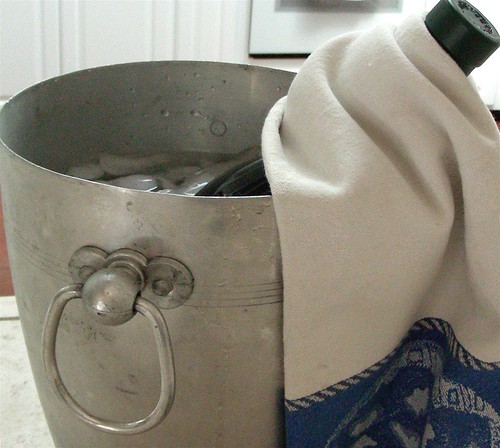
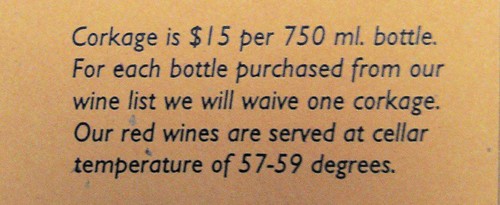
At this point, the solution is to ask the waiter for an ice bucket to chill the wine. Now, in few cases, I even had the waiter argue with me that ice buckets were for whites only and much too cold for reds. Therefore, I was extremely pleased when I found the following lines on the wine list of a new restaurant in Palo Alto:


It is always a good sign when a restaurant seems to care about wine. This means that you'll most likely find a wine in the wine list that will work well with the food. And it is even better if the wine is served at the proper temperature.

If a wine has been ordered by the glass and is too warm, the problem is trickier. I sometimes prefer to order the ubiquitous Chardonnay that I known will arrive nicely chilled rather than having a warm red. The alternative is to chill the wine with a few ice cubes, stir, and quickly remove them before they melt completely and dilute the wine too much.

That evening at Mantra we ended up not ordering a red wine — instead, we felt like having an Austrian Riesling with our dishes — so I don't know if the restaurant really serves red wines at cellar temperature. Next time, I should find out.

Technorati tags:

Tuesday, September 05, 2006

Blind tasting of Grenache-based wines

For me, Grenache is the quintessential summer grape. It is often an essential component of the red and rosé wines that we enjoy drinking during the warm and sunny season. It was also the theme of our latest wine tasting gathering where we blind-tasted six Grenache-based wines from Spain, Italy, Southern France, Australia, and California.

Most likely, Grenache comes from Spain where it is known as Garnacha. The grape is extremely heat and drought resistant and thrives in warm and dry climates as well as in poor soils. As it ripens slowly, it can reach high sugar levels. Grenache can produce different wine styles varying from light, fruity rosés, thanks to its thin skin with little pigment on it, to full-bodied reds and rich dessert wines. In the south of France, it is traditionally blended with Syrah, Mourvèdre, Cinsaut, and Carignan, in Spain, with Tempranillo and in Australia, with Syrah and Mourvèdre in the so called GSM wines. In California, Grenache counts to only 2.6% of the total wine grape acreage but a growing number of wineries known as the Rhone Rangers are dedicated to actively promoting the Rhône varieties in California, including Grenache.

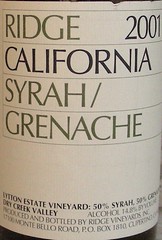
Ridge Vineyards is one of the Rhone Rangers member wineries. The winery produces various rhone style wines using Carignan, Grenache, Mourvèdre, Petite Sirah, and Syrah grapes. The 50% Syrah/ 50% Grenache blend from Ridge's Lytton Estate was the first wine that we tasted. The Lytton estate is located north of Healdsburg, on the hills separating Alexander Valley from Dry Creek Valley. Ridge's involvement with Grenache in the early 70s happened quite by accident when a high percentage of Grenache vine interplanted with small amounts of Zinfandel and Petite Sirah was discovered on one of the hills. Since then, Ridge bought additional vineyards including a thirty-two-year-old mixed Grenache blockland and 3.2 acres of mature syrah. The 2001 Ridge Syrah/Grenache Lytton Estate had a deep garnet color and a bright nose of sweet vanilla and red berries. On the palate, it was rich, slightly tannic, and well balanced with tasty sweet fruit flavors and a mineral-iron finish. Half of us ranked it first which put the wine in first position.

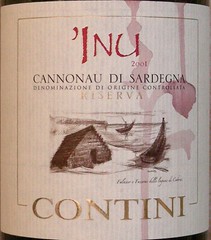
The second wine took us to Sardinia where Grenache is known as Cannonau. Grenache was probably brought there by the Spaniards during their rule of the island between the 15th and the 17th centuries. The 2001 Contini Cannonau di Sardegna Riserva 'Inu had a dark color and a spicy and fruity nose. On the palate, it was full-flavored with a characteristic Grenache taste. That was a pleasant wine that ended up in the fourth position.

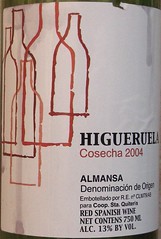
Our third wine came from Almansa, a little-known wine region located in Spain's Castilla-La Mancha. The 2004 Bodegas Tintoralba Higueruela gained significant notoriety when it was rated 90 points by Robert Parker. The wine had a spicy nose of sour cherry and blackberry. On the palate, it was smooth and concentrated with some acidity and a fruity aftertaste. The wine finished second.

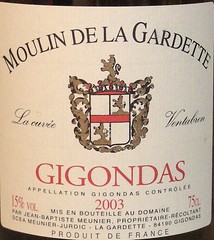
Our fourth wine was the 2003 Gigondas Moulin de la Gardette Cuvée Ventabren. The winery name Moulin de la Gardette refers to an old windmill that once stood on the stony hill of La Gardette just outside the village of Gigondas Designed for long term aging, the Cuvée Ventabren is a blend of 70% Grenache from very old vines, 20% Syrah and 10% Cinsault. The wine had a dark red color and a nose of raspberry liqueur. On the palate, it was still tight and tannic with sweet and peppery flavors. The wine finished in fifth position.

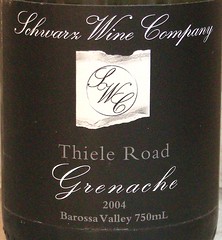
Our fifth wine, the 2004 Jason Schwarz Thiele Road Grenache Barossa Valley, came from the Barossa Valley in South Australia where Grenache vines are some of the oldest in Australia. Jason Schwarz is the son of an independent grape grower with over 100 acres of vineyards in the Barossa Valley. In 2001, Jason decided to make his own wine and now produces a Syrah and a Grenache from the family vineyards. The nose of the 2004 Grenache was sweet and spicy. The palate was big with sweet strawberry candy and raisin flavors and some definite heat on the finish. For me, the wine was too sweet with too much alcohol and I found out later that the 2004 vintage had an unusual 16% alcohol and 6 grams/litre of residual sugar. The wine was ranked last.

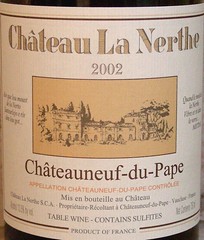
Our last wine came from Château La Nerthe, one of the main producers in Châteauneuf-du-Pape and one of the most historic domains in France—the wines of Château La Nerthe were served at the court of Louis XVI in Versailles. One of the property's owner was the eminent Commandant Joseph Ducos, the first French grower who imported American rootstock to overcome the phylloxera epidemic, and who is remembered as the soul of the viticultural reconstitution. The 2002 Châteauneuf-du-Pape Château La Nerthe had a medium ruby color and a earthy nose of sweet berry and jasmine aromas. The palate was round, fruity, and peppery. For a Châteauneuf-du-Pape, the wine was rather light and easily overpowered by the Schwarz Thiele Road Grenache (2002, known as the "flood" vintage, produced light wines in the Southern Rhône). But, as the dinner progressed, I found the wine to be one of the most food friendly and balanced of the tasting. The wine finished in third position.

Wednesday, August 30, 2006

Slow Wine

There was an article on slow wine in the Summer edition of Edible San Francisco, that featured an interview of Randall Graham, the iconoclastic winemaker of Bonny Doon Vineyard. Most of us are familiar with Slow Food, the international movement opposing fast food, but who has any idea of what a slow wine is?

“Essentially, slow wines are complex.” explained Grahm when asked to share his latest thoughts on slow wine and slow winemaking, “They're rich in minerals. The more minerality that one is able to extract from the vines, and the less obscene the degree of overripeness at which one harvests the grapes, the slower the wines tend to be.” And then he added on the virtue of slowed wines: “Slow wines are unique and therefore irreplaceable. They cannot by definition become commodities. Slow wines are the ones that enliven the spirit, take your breath away with their complexity, and generally make you believe that despite all the travails of this mortal existence, life is worth living.” The whole interview can also be found on the slow food forum.

Curiously, a few days ago, as I was reading Lawrence Osborne's excellent book The Accidental Connoisseur: An Irreverent Journey Through the Wine World, I found a similar quote from Mitchell Klug, at the time vineyard manager for Mondavi: “You can see it everywhere, this culture of instant change. But with wine you hit a problem. Our culture is fast, but wine is slow. It takes decades. The irony with all these novelty cult wines is that wine has a different mentality from commodities that can change very quickly. It isn't music or fashion or software. You can't change a vineyard overnight.”

I had not realized until now how trenty the slow wine concept was, but now I am wondering: what is more important, the quality of a product or how it is consumed? Can a slow wine really be slow unless it is enjoyed by a slow consumer, I mean someone with a convivial attitude, someone that can take the time to share long meals with friends? Who really makes a wine slow? The winemaker or the consumer?

Technorati tags:

Thursday, August 24, 2006

Tasting the 2005 Hook & Ladder The Tillerman White and the growing influence of wine blogs

Do you think that wine blogs have a growing influence on the wine community? Tom Wark from Wark Communication and the Fermentation blog believes so: “The Wine Blog is one of these new information sources that people are paying attention to on a daily basis and using to shape their worldview. And their numbers are growing as well as their influence.” he told a group of wine professionals in a presentation entitled Blogs, Wine Blogs and Communication.

Michael De Loach, head of sales & marketing at Hook & Ladder winery, agrees: “Our family has been in the wine industry for more than 30 years. In that time we've seen lots of changes. When the growth in personal websites and wine blogs was pointed out to me, I was amazed and heartened. It appears that technology has helped ferment a renaissance in wine publishing. I couldn't be happier. It is exactly what this industry needs.”

And therefore, he sent me and other wine bloggers a sample of his 2005 The Tillerman White so that we could talk about it on our blogs.

The owner and winemaker of Hook & Ladder is Michael's father, Cecil De Loach. He is a former San Francisco firefighter and the winery was named to honor this 16-year career: Hook & Ladder is another name for a fire truck. Before launching the winery in 2004, he was also known as the founder and winemaker of De Loach Vineyards, pioneering the Russian River Valley as one of California's premier grape-growing regions since the mid 70's.


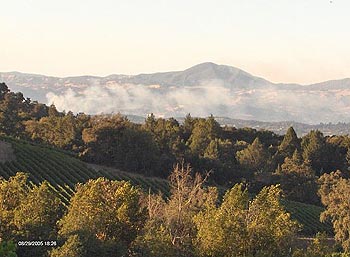
The Russian River Valley


I was pleased to read on the winery website that Cecil and his wife Christine De Loach were both very committed to keeping the Russian River Valley environmentally sound. They have implemented a number of environmentally friendly actions such as creating an oak tree nursery, placing barn owl boxes and raptor perches to promote natural predator-prey relationships, and conserving water.

The winery grows many different grapes from various parts of the Russian River Valley, including Chardonnay, Gewürztraminer, Pinot Noir, Zinfandel Cabernet Sauvignon, Cabernet Franc, Merlot, Sangiovese, Syrah, Petite Sirah, Grenache, and Mourvèdre. Two blends are produced, a red and a white, which are both named The Tillerman. This is another reference to Cecil De Loach's firefighter job: because a fire truck needs two steering wheels, there are two drivers; one is in the front, and one, called the tillerman, is in the back.

According to the winemaker notes, the 2005 Hook & Ladder The Tillerman White is a proprietary blend of three estate varietals. It is made using a 100% stainless steel/cold fermentation technique to get a fruit-forward, crisp, expressive wine. The winemaker would not disclose the exact composition of the blend because it will eventually change over time in order to create a consistent flavor profile.

While I felt honored to have been asked to review this wine sample, I have to confess that I was slightly anxious when I opened the bottle. What if I didn't like the wine? Would I still be able to talk about it? I poured a little of the wine in my glass and quickly felt relieved. The wine had an attractive light straw color and an aromatic nose of ripe apple, pear, and white peach. On the palate, it was dry, round, with a refreshing vivacity. I also detected some honey and light spices on the finish. Overall, I found the wine thoroughly pleasant and perfect for a relaxed sipping. Try it with a appetizer of lavosh bread, hummus, and olives.

As for the blend, I agree with Tim Elliott from Winecast who also reviewed the wine: Chardonnay and Gewürztraminer, the two estate white grapes, must be part of the blend. And the third varietal? The obvious choice would be the aromatic Viognier but the grape might be too golden to match the light color of the blend. My other guess is Pinot Gris, a superb cool climate grape that has recently gained in popularity in the Russian River Valley.

Technorati tags:

Monday, August 21, 2006

The incredible lightness of Arbois Rouge

A week ago, we had the visit of my husband's parents from France. My father-in-law being a wine lover and an amateur of fruity, low-alcohol, and light-bodied wines, I took the opportunity of their visit to discover—or rediscover—some lesser-known regional wines. One evening we tasted an Arbois rouge that I found particularly noteworthy.


The village of Arbois


If you had the chance to read Edward Behr's well documented coverage of the wines of Jura in the last issue of The Art of Eating, you must be now fairly well acquainted with the region. It is a mountainous massif between Burgundy and Switzerland with Arbois being one of the main communes and appellations. Arbois, which means fertile soil in celtic, is also the childhood home to Louis Pasteur, sometimes called the father of oenology.

The appellation produces a wide variety of wines including red, rosé, and white wines, sparkling wines, sweet vins de pailles and of course the distinctive vins jaunes. The red wines are usually blends of Pinot Noir, Poulsard, and Trousseau. Pinot Noir produces a much lighter wine than in Burgundy and is mostly used for blending. Poulsart is a thin skinned grape native to the Jura producing delicate, lightly-colored wines. Trousseau is more robust and brings color and structure to the traditional Trousseau-Poulsard or Trousseau-Poulsard-Pinot Noir blends. It is also found in Portugal under the name of Bastardo where it is used for Port.

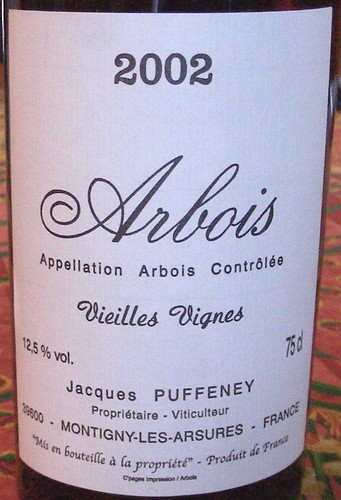
The 2002 Arbois Rouge Vieilles Vignes Jacques Puffeney had a pale red color. I found the nose very distinctive with notes of tart cherry, dried flowers and spices. On the palate, it was dry, refreshing, almost like a rosé, and certainly, incredibly light.

Technorati tags:

Thursday, August 10, 2006

Chard No Way!

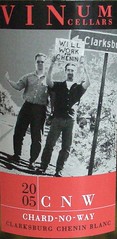
When I bought the 2004 Montlouis Clos du Breuil François Chidaine, my recent contribution to Wine Blogging Wednesday, I also found a bottle of California Chenin Blanc, the 2005 Vinum Cellars Chenin Blanc CNW (Chard No Way) Cuvee. So I bought the wine, curious to see how Chenin Blanc from a warmer climate would taste.

Vinum Cellars is one of the few California wineries that makes Chenin Blanc. The reason is that the two founders and winemakers, Richard Bruno and Chris Condos, both share a long-standing passion for Chenin Blanc: “It is our belief that Chenin Blanc (when made well) rivals some of the greatest white wines of the world. This wine was made from cool climate grapes, barrel fermented in French Oak, and aged for 9 months. Blah, Blah, Blah, Blah, Blah...REDISCOVER CHENIN BLANC!&rdquo

The Chenin Blanc grapes come from Wilson Vineyards in the Clarksburg AVA. This out-of-the-way region is located west of Sacramento and has a unique combination of soils, water, and climate. The soils are rich in organic material with a high mineral content. The Sacramento River provides an abundant source of water. Daytime temperatures are not as high as in nearby Sacramento thanks to cooling breezes coming from San Francisco Bay and rolling into the Sacramento delta. Chenin Blanc and Petite Sirah grow particularly well in this area.

The 2005 Vinum Cellars Chenin Blanc CNW Cuvee has a pale yellow color. The nose is aromatic with expansive fruity and floral notes. On the palate, the body is quite full with some good acidity and ripe fruit flavors. Although it does not have the sharp minerality of a Loire Valley Chenin Blanc, it is nevertheless very pleasurable to drink. And for the price, Chard No Way!

Technorati tags:

Tuesday, August 08, 2006

Poetic tasting notes

Jim Harrison's latest piece in Kermit Lynch's August Newsletter, entitled Vin Blanc, was a real treat to read. The novelist and poet has to reduce his consumption of red wines due to health reasons and is therefore discovering the flavors of white wines.

When Kermit Lynch sent him a case of whites to sample, he “felt immediately trapped by the ineffable mystery of taste.”, and then added: “So this case of varied white wines trapped me both in my own limitations as a writer and in the rather obvious limitations of language itself. I make countless aesthetic decisions when composing a novel but am far less comfortable making critiques of the work of others.”

Nonetheless, can you find anything more eloquent than these little gems of tasting notes?

Domaine de la Tour du Bon 2004 Pretty good but a little sweet for my taste. Acceptable on a warm twilight watching birds from our patio in Patagonia, Arizona. One of the thousands of wildflowers I can't name even though I like them all. Naturally had to open a red for the rather musky buffalo shank stew I had made for dinner.

Philippe Faury Saint Joseph 2004 My father was an agronomist who with eyes closed could name the weeds and grasses he smelled. Naturally I can detect a herring egg sandwich when I bite into it. In this wine I can taste the stones of the Rhone Valley. The place suits me and so does the wine.

Ermitage du Pic St. Loup This was also easy because I love the terroir, and had pleasant memories of drinking it in a cafe in the grand square of Montpellier while watching the prettiest woman in France walk by. This wine tastes as soft and pleasant as the back of a girl's knee after she has taken a dip in the Mediterranean. I drank it with the light-breasted scaled quail I had shot, then downshifted to the mighty Vacqueyras, Sang des Cailloux, for the shoulder of wild pig.


Technorati tags:

Wednesday, August 02, 2006

WBW #24: A fine Chenin Blanc from Montlouis-sur-Loire

Today is Wine Blogging Wednesday and for the second anniversary of this popular wine blogging event, Alder of Vinography has asked us to drink a Loire White as he think that the Loire Valley is the most underrated wine regions of France.

And I believe that Chenin Blanc is the most underrated grape variety. Like Riesling, it is made in a wide variety of wine styles: light sparkling wines, bone dry table wines, as well as unctuous dessert wines. Thanks to its high acidity, it can produce wines that are capable of aging for many decades. And it is also extremely food friendly.


An old Chenin Blanc vine in Vouvray


Chenin Blanc is Loire's signature white wine grape and has been well established in Anjou since the 9th century. It was later exported to Touraine, also called the garden of France, where it thrived in the highly calcareous soils of the region, especially around the towns of Vouvray and Montlouis-sur-Loire. Sadly, as light red wines became highly popular in Parisian Bistros in the 1970s, plantings of Chenin Blanc in Anjou and Touraine has been inevitably replaced by the more profitable Cabernet Franc and Gamay varieties.

Vouvray and Montlouis-sur-Loire are just across the river from each other but for some reason, Montlouis has never enjoyed the high reputation of its neighbor. Maybe it is because of its lighter, sandier soils, or maybe it is its tiny size: 380 hectares planted exclusively with Chenin Blanc.

For a long time, all I knew about Montlouis was the inexpensive sparkling wine that my grand-father used to buy from a local vigneron. It was our poor man's Champagne, relatively bland in flavor, nonetheless bright and bubbly, which was what we needed for our family celebrations.

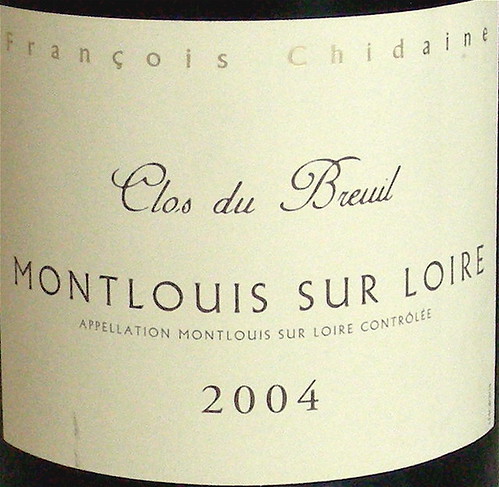
The 2004 Montlouis Clos du Breuil François Chidaine that we tasted last night was of a different caliber. François Chidaine is one of the most serious producers of the region. He believes that “wine is born from the vine, not from artificial skills of re-creation in the winery”, and his 16 hectares estate, made of eight distinct plots, is organically farmed. Clos du Breuil is one of these plots. It has a soil of clay and limestone with flint and is always vinified separately as a Montlouis sec.

The wine had a bright golden color and a light, mineral nose with undertones of stone fruits. On the palate, it was crisp, dry, mineral, with also some roundness, leaving an aftertaste of white peach. We enjoyed the wine with some halibut filets baked in a Thai-inspired curry sauce. This reinforced my conviction that, like Riesling, Chenin Blanc loves Asian spices.

Thanks Alder for hosting and choosing this inspiring theme!

“et avec gros raisins chenins estuverent les jambes de Forgier mignonnement, si bien qu'il feut tantost guery.” (and with big grapes of chenin cutely bathed the legs of Frogier, so that he soon was cured)
François Rabelais, Gargantua.

Technorati tags:

Thursday, July 27, 2006

1979 La Crema Viñera Tasting

One of my wine lover friend, James Strohecker, had recently the great opportunity to attend a 1979 La Crema Viñera Tasting dinner, hosted by wine collector George Kautzman. He sent me some great tasting notes and was kind enough to let me post them on this blog.
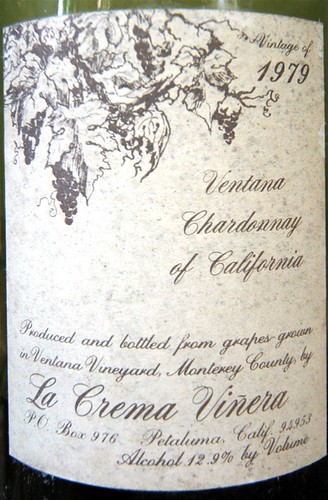

1979 La Crema Viñera "Ventana Vineyard" Chardonnay (Magnum)


One of the best kept secrets in the history of California winemaking was a small winery started in Petaluma in the late 1970's called La Crema Viñera. Their first vintage, 1979, saw the emergence of three "super-premium" wineries, all of whom received the scarcest and most highly sought after grapes in all of California -- Winery Lake Vineyard, in Carneros.

I was lucky enough to be invited to a tasting hosted by famed wine collector, George Kautzman, who had scurried away every 1979 La Crema Viñera creation.

George Kautzman’s Original Background Notes:

The three upstart wineries were Acacia, Kistler, and La Crema Viñera. Of these three, there is no question that the finest wines produced that first year were from La Crema Viñera. (The name and assets were later sold, eventually becoming La Crema, part of Jess Jackson's wine empire, but the winemaker and grape sources were long gone.)

Rod Berglund, La Crema Viñera's winemaker when they launched in 1979, will be here to talk about their inaugural wines. I have been holding every wine La Crema Viñera produced their first year, including Magnums of 5 of the 7 wines (the other two were only produced in 750 ml's). As a hint of what's in store for us that evening, I brought a 750ml bottle of the 1979 La Crema Viñera "Winery Lake Vineyard" Chardonnay to the Francois Audouze dinner on May 1, and you can visit that thread to view the raves this wine received that night. Imagine what it will taste like from a Magnum! The scarcity of these wines, and the chance to taste them from Magnums, assures that this tasting will probably never be duplicated....

These are my tasting notes on the lineup:

1979 La Crema Viñera Vin Gris Pinot Noir (two 750 ml's)
As George Kautzman pointed out, the two bottles he selected were twin (750 ml) “brothers” out of the same case – one tuned out fine and went to an outstanding university such as the University of Oregon. The other went to Soledad Prison near where its grapes were grown.

This was the tale of two completely different wines, same vintage and bottling. The first bottle was clear; and the second had a smoky, caramel tainted look.

Interestingly, Rod Berglund and his original business partner were talking about this wine: They’d essentially made it to last a year at most.
• Light bottle 1979 Vin Gris Pinot Noir: Excellent. Tangy and tart. Very nice; almost “young” and still with some bounce on the palate. No real heaviness or excessive sugars.
• Dark bottle 1979 Vin Gris Pinot Noir: Very sherry in the nose; mushroom taste. It had turned and was too far gone for me. *However,* there were a few tasters in the group who actually liked it and later thought it went well with the dinner course of Mushroom-covered bread.

2005 Ladd Cellars Russian River Valley Pinot Noir Rosé
Let me start by saying I really don’t care for Rosé. Don’t like it. Never have. Always too fruity or made for a different palate. Or maybe it’s a reflection of growing up in a family supermarket where we sold Gallo Rosé. And not surprisingly, of my two favorite Pinot Noir brands/winemakers, I don’t like David Bruce’s Rose, and if Ancien’s Ken Bernards made one, I’ll say that I wouldn’t like it either. It’s just not a wine I care for.

But this wine really changed me -- I really liked this Ladd Cellars Pinot Noir Rosé. It was unique – in more ways than one. Supposedly, this was one of only 12 bottles in production. The Rose was very crisp with a nose of fruit blossoms and passion fruit. The flavor was an intense, full Pinot grape flavor, with a tangy finish. It was young and powerful – and only opened up slightly over time. I rated this the fourth-place wine of the evening.

1979 La Crema Viñera "Winery Lake Vineyard" Chardonnay (Magnum)
The nose was oak and apricots, that eventually flattened out a bit. It tasted like Chenin Blanc and Marigolds; but was very fresh and clean with a silky-soft finish with a twinge of Nectarines on the palate. An excellent, surprising start to the Chardonnays.

I rated this my third favorite wine of the evening, and spicier and more bouncy than the Ventana Vineyard Chardonnay that followed it.

1979 La Crema Viñera "Ventana Vineyard" Chardonnay (Magnum)
This wine nosed very buttery – I first wrote, “butter and lobster,” but that could have occurred from the aroma of our first dish, a Lobster Ravioli appetizer.

Later, when I tasted it again, it had a butter and kumquat nose, with a lime-rind (lime zest) citrus-and-hay finish. Though this flattened out a bit as well, it stood the test of time as a solid Chardonnay that was slight and smooth on the palate

1981 La Crema Viñera (51% Monterey/49% Sonoma)
This was fresh with still some room to move, but probably best to drink now. Smooth, smooth, smooth. Balanced. A touch of smoke and rose on the finish. Good citrus twinges and as the evening progressed, you could taste the blend – but the flavors never fell apart. Well melded when made and now at the tasting.

1979 La Crema Viñera "Winery Lake Vineyard" Pinot Noir (Magnum)
Raspberry and cocoa. Smooth (of course) and classy finish. Barn-color on the edges gave away its age.

The nose was lighter and more delicate than the Ventana Pinot Noir. Later, the tastes that emanated were lake water + minerals + raisins. Nice. This really was excellent and was my second favorite wine of the evening

1979 La Crema Viñera "Ventana Vineyard" Pinot Noir (Magnum)
Yum. Smoke On The Water. Older musky nose and a light finish. Big. Lots of late-palate blackberry. And an unusual, spice-filled finish. With a tart lingering flavor. Much different than the Winery Lake Pinot Noir. More hearty. And though it never boomed with new flavors, it remained remarkably strong during the tasting; it didn’t flatten out.

1979 La Crema Viñera "Roberts Vineyard" Pinot Noir (one 750 ml)
First of all, George has 11 bottles of this . . . somewhere in his vast collection. Secondly, and more importantly, he could only find one 750 ml out of the 11 he has. So he also provided a 1980 Roberts Vineyard Pinot Noir (see below)

1980 La Crema Viñera "Roberts Vineyard" Pinot Noir (two 750 ml's)
BIG. Fruity up front nose that never diminished. Tanin and black cherry. More fruit. Drinkable and delicious. Almost un-Pinot Noir like à very deep. Many layers. With a smoky, interesting BIG final pow on the palate. Wow. This is great wine.

This clearly stormed to the top of the list and stood out as my (and others’) Number One selection of the evening. Well crafted and it aged very well.

1979 Petaluma Cellars "Steiner Vineyard" Cabernet Sauvignon (Magnum)
Silky and sweet nose. Dark and full with hints of Boysenberry and Oak. Tanin-rich with a spicy finish. This was Zinfandel-like on my palate; although smooth, it’s not a knock-down Cab. Later, I smelled hints of Mrs. Neushin’s Dill Pickle juice, with a smoky back. Though this was polished, it was a bit past its prime – no palate increase; it flattened out.

Frankly, I wasn’t as blown away by this wine as others were. Many raved long and loudly about this Cabernet. I felt it had settled a bit too much and thought that it was a little too raisiny for my taste.

1983 Graham’s Vintage Porto
Wow! Smooth and medium-sweet with a Wild Berry finish. No sediment. Very smooth and not overbearing with alcohol. A fine finish to the evening.

James Strohecker

Technorati tags:

Friday, July 21, 2006

Montana trip: reaching its apogee on the Flathead River and with L'Ecole No 41

We ended our Montana trip with a day of rafting on the scenic Middle Fork of the Flathead River, at the southern boundary of Glacier National Park. Although most of it is mild whitewater rafting, the river has a few exciting class III rapids with fearsome names such as Tunnel, Bonecrusher, Jaws, Waterfall Narrows, and C.B.T. (Could Be Trouble). For us, Jaws was maybe the most thrilling of them all. It is where our 12 year old daughter suddenly fell out of the boat in the turbulent waters. Fortunately, she did not panic, swam back to the boat, and was quickly brought safely on board.


Rafting on the Middle Fork of the Flathead River, Montana


After all the excitement of the day, we really deserved a gratifying dinner. We were staying in Whitefish, Montana, which is a ski and summer resort with a lot of good restaurants. We decided to try Tupelo Grille, a restaurant specialized in Cajun and Southern cuisine. The place had also a fine wine list with a good selection of wines from Washington State.

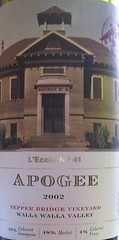
I chose a 2002 L'Ecole No 41 Apogee to go with our entrees. Apogee means the point in an orbit most distant from the body being orbited. It is also the farthest or highest point; the apex. “We chose the proprietary name, Apogee, because its definition seemed to reflect all that we were trying to accomplish with this wine....reaching the highest point.” explains Martin Clubb, the winery co-owner and winemaker on the winery's website.

Apogee is a classic Bordeaux blend from the reputable Pepper Bridge Vineyard in the Walla Walla Valley. The wine was really enjoyable with our meal, rich but well-balanced, with plenty of dark fruit flavors and a long finish. And what a great way to end our Glacier adventures!

Technorati tags:

Wednesday, July 12, 2006

Hiking in Glacier National Park and tasting Canadian ales

I am just back from a awesome hiking trip in Glacier National Park, Montana. Of course, we had many adventures, saw big horn sheep, mountain goats, marmots, and I still remember the fear I had when I saw my first Grizzly bear!

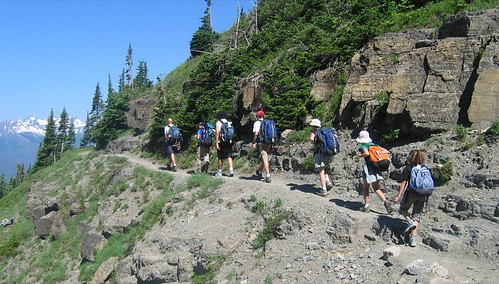
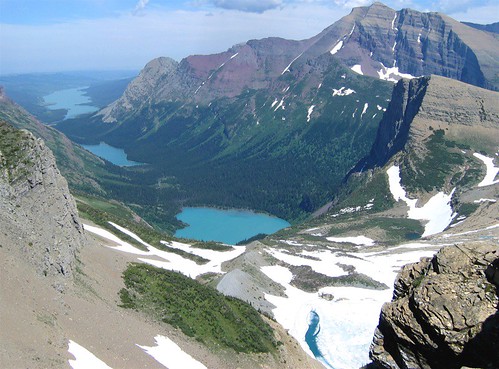
Our trip started with a 7.6 mile hike on the Highline Trail that took us to the Granite Park Chalet, a rustic backcountry chalet only accessible by trails.


Hiking on the Highline Trail


As we stayed two nights at Granite Park Chalet, we hiked the following day up to Swiftcurrent Lookout, which sits at 8436' on the Continental Divide, and to the Grinnell Glacier Overlook, looking down onto one of the largest glaciers of the park.


Grinnell Glacier Overlook


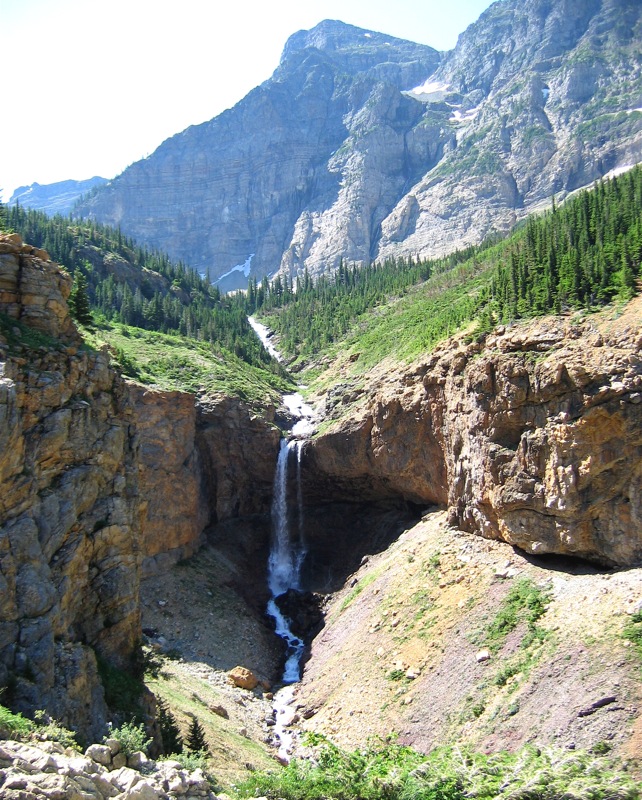
Then we drove to the bordering Waterton Lakes National Park, located in Alberta, Canada. This part of the park offers many interesting hikes too, including the Crypt Lake trail, one of Canada's best-known trails. It is a full day hike that takes you to great waterfalls, an iron ladder climb, a natural tunnel, an exposed cliff traverse, and finally a hidden alpine lake surrounded by snow covered peaks.


The 600 ft cascading Crypt Falls


Alberta's main brewery is the Big Rock Brewery, which offers a pretty good selection of brews from light, crisp lagers to rich, full-flavored stouts. Among the ones we tasted, our favorites were the Traditional, an English-style amber ale, the McNally's Extra, a stronger Irish-style ale with a 7% alcohol content, and on the sweeter side, the Honey Brown Lager with a touch of clover honey. After a long day of hiking, I can tell you: these beers were absolutely delicious!


Technorati tags:

Friday, June 30, 2006

WBW #23: Grilled shrimp Charmoula sauce and Rueda

Bar-B-Que Wines is the theme for the 23rd edition of Wine Blogging Wednesday and Vivi at Vivi's Wine Journal is hosting. She asked us to fire up the grill, choose a wine, look at it, sniff it, taste it, drink and then write something about it before Wednesday July 5th. I'll be on vacation next week &mdash hiking in the Glacier National Park — so here is my contribution, a little bit ahead of time.

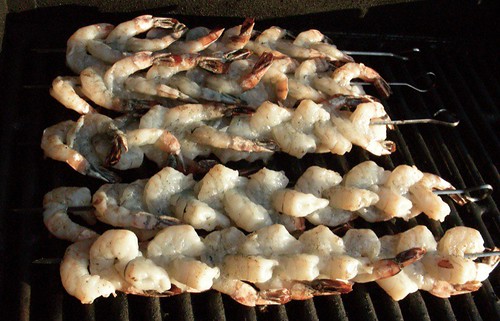
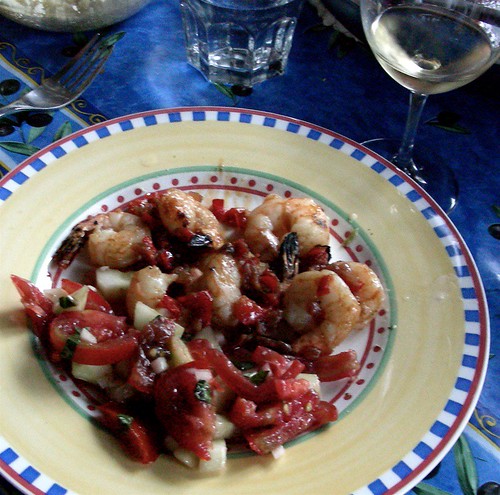
Choosing which wine to talk about for this WBW was actually a challenge because we have been firing up the grill almost every day since the beginning of the warm season and drank many different wines with our barbecued food. But then, last weekend, we made this delicious grilled shrimp recipe with Moroccan Charmoula sauce.


While the shrimp were grilling, I opened a bottle of 2003 Viña Sila Rueda Naiades, a 100% Verdejo wine. Considered to be the finest white variety in Spain, Verdejo is a native grape of Rueda, a wine region located in central Spain, northwest of Madrid, along the Duero river. Thanks to its sandy and chalky soils, Rueda can produce aromatic Verdejo wines of great minerality and body.

We looked at the wine: it exhibited a bright color with a pretty golden hue. We sniffed it: the nose was fragrant with floral and stone fruit aromas. We tasted it: it was full-bodied with a rich texture, almost like a Chardonnay but more aromatic. We drank it: it stood up to the spicy sauce very well. I made a note to buy more Rueda in the future.


Another great theme for WBW, thanks Vivi! And see you in 10 days or so!

Technorati tags:

Tuesday, June 27, 2006

Pairing wine with Soccer

I can't believe that since the beginning of the Soccer World Cup, we have been watching an average of two Soccer games per day. For me, that's a lot of time spent in front of the TV, but watching these soccer games is simply too addictive!

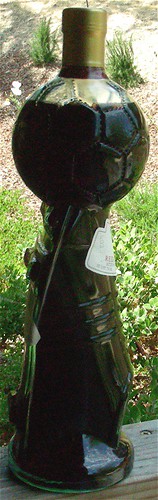
Last weekend, we invited some friends to watch Argentina-Mexico, the first game of the round of 16. For the occasion, my sister in law brought an amazing soccer ball and shoe-shaped bottle of wine.

The wine inside was unfortunately not as memorable as the bottle itself. Produced by Cantine Fratelli Bellini, the Bellini Favola Vino da Tavola Rosso was a non vintage red blend of unspecified composition. It had a deep garnet color and some light cherry aromas on the nose. On the palate, it reminded me of some of the Chiantis of the past, too lean and tart to be well balanced. We finally switched to the fine 2002 Luigi Bosca Cabernet Sauvignon Reserva in honor of Argentina's victory.

Technorati tags:

Monday, June 26, 2006

It's Too Darn Hot, I need a glass of rosé!

It was very hot last week in the Bay Area, with unusually high evening temperatures. Many people would quench their thirst with an ice-cold beer — one of the most refreshing beverages men had invented &mdash, but with the lamb that we were having for dinner, I did not feel like having a beer. On the other hand, a bottle of rosé that I had put in the fridge a few days before, was just screaming to be open.

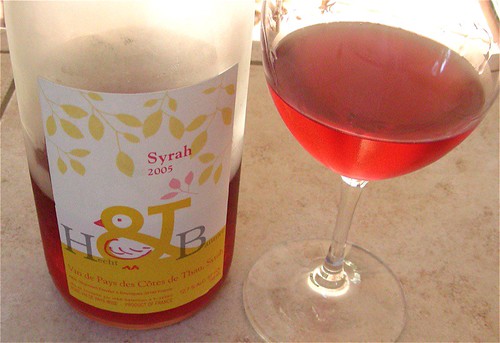
A rosé is usually a crisp, fruity, and uncomplicated wine that can be served as cold as beer. It is also very versatile and can go with almost any kind of food. My bottle of rosé was a 2005 Vin de Pays des Côtes de Thau Rosé Hecht & Bannier, a varietal wine 100% Syrah produced by a friend of our friend Arnaud and now imported by K&L Wine Merchants.


The wine had a bright watermelon color and a sweet nose of wild strawberries. On the palate, however, it was dry, clean, leaving a crisp and refreshing sensation on the finish. It worked well with the lamb too.

It's too darn hot, sang Ella in the background, too, too, too darn hot.

Technorati tags:

Tuesday, June 20, 2006

A tapas party and two Spanish wines


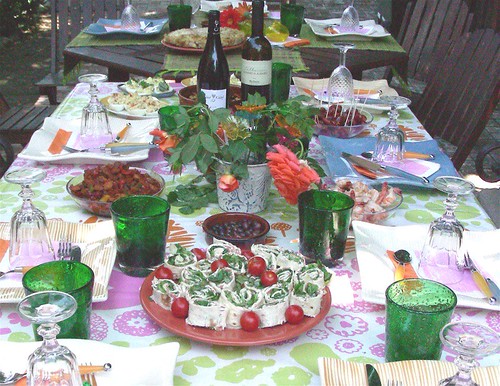
Making tapas is an easy but festive way to throw a summer party


For all of us, tapas are small plates of tasty appetizer-sized food served with beer, wine, or sherry, but literally, tapa means cover in Spanish. The word has different interesting etymologies that explain how the concept of tapas was born. One, commonly used, is that bartenders used to place flat items like saucers, cards or even bread on top of glasses of wine to protect them from flies. Eventually they topped these covers with snacks to attract more customers. A slightly different story says that bartenders, discovering that mature cheese could cover the taste of bad wines, decided to offer free slices of cheese with cheap wine.

Today, it is fortunately rare to have tapas with cheap, bad wine. My first great tapas experience occurred some years ago at my sister in law's wedding near Badajoz, Spain. Following the local custom, the wedding dinner started with an abundance of sliced Serrano ham, Manchego cheese, and olives, served with the traditional glass of Manzanilla. Sherry is an acquired taste and I have to confess that until that night, I didn't like this unusually yeasty, slightly salty, dry wine. But this wedding made me a convert.

More recently, we organized a little tapas party with some friends of mine and I was asked to bring the wine. This time, I did not dare bringing any sherry, as I was not sure whether any of my friends would like it. Instead, I chose a crisp white wine from the cool and wet Galicia on the Atlantic coast, and a Grenache-based red wine from the hot Priorat region on the Mediterranean coast, just south of Barcelona.


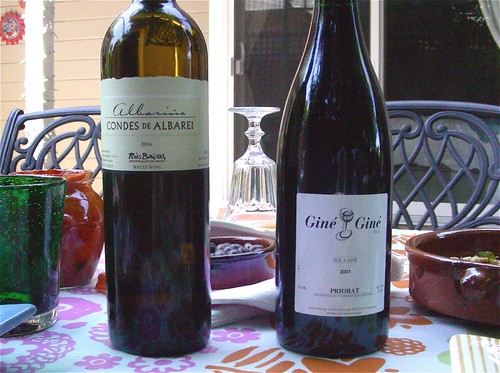
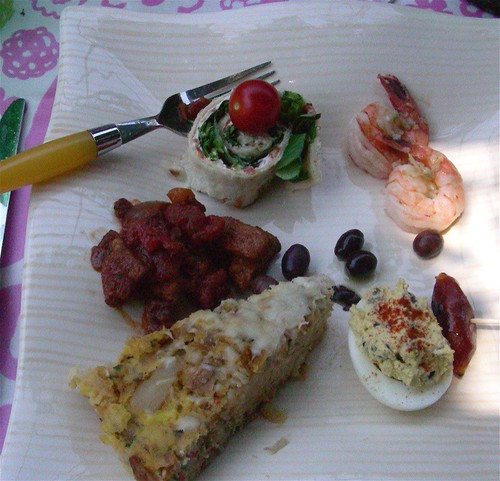
The 2004 Condes de Albarei Albariño was, without doubt, our favorite. It had a bright stray color with a light green hue, with attractive white flower and peach aromas on the nose. On the palate, the wine was mouthfilling with a bite of acidity on the finish, which made it the perfect complement to our gambas al ajillo (garlic prawns) and abuelita querida (goat cheese and chorizo rolls) dishes.

The 2001 Giné Giné Priorat had a deep garnet color with a nose of blackberries and distinctive notes of mint and eucalyptus. On the palate, it had a medium intensity with good acidity on the finish. The wine worked well with the traditional tortilla de patatas (Spanish omelet), as well as our carne con tomato dish (pork cubes in tomato sauce).


But next time, for sure, I'll also bring a bottle of my favorite Manzanilla, the Hidalgo La Gitana and I'll start converting my friends to the distinctive flavors of sherry.

Technorati tags:

Wednesday, June 14, 2006

WBW #22: 1999 Château Langoa Barton

Today is Wine Blogging Wednesday, hosted by Tim Elliott of Winecast. For this 22nd edition, Tim asked us to choose a lite (alcohol) red wine, meaning 12.5% alcohol or less. With this theme, Tim brings up an important issue: the rising alcohol levels in almost all the wines worldwide.

Alcohol is an essential component in wine. It is a powerful flavor extractor and it gives wine body and a sweet mouthfeel. However, if the alcohol content is too high, the wine can be out of balance, heady, and leave a hot, burning sensation in the mouth.

Drinking wines with high alcohol content can be an issue for wine lovers that want to moderate their alcohol intake. A 5-ounce glass of 9% German Riesling contains 0.45 ounces of ethanol. A similar serving of 14% California Chardonnay contains 0.7 ounces of ethanol. Moreover, pairing high alcoholic wines with food can be challenging as they easily clash with well-balanced dishes.

Now, the level of alcohol that is specified on the wine label may not be exactly what you think you're going to get. According to the Epicurious Wine Dictionary, “for table wine, the United States requires a minimum alcohol level of 7 percent and a maximum of 14 percent. The label variance can be up to 1.5 percent. For example, a wine stating "Alcohol 12.5% By Volume" can legally range anywhere from 11 to 14 percent.”

Many wines from Bordeaux can be found at 12.5%, although Bordeaux follows now the general upward trend and I have seen some 2002 wines that are already at 13%.

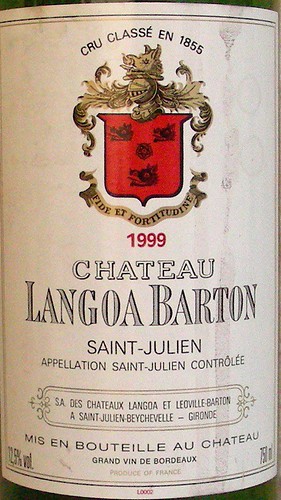
The 1999 Château Langoa Barton was the wine with an alcohol level of 12.5% or less that we drank the most recently. We shared this bottle the other night with a good friend of ours that was visiting from Chicago.

Château Langoa Barton is a classified third growth from the Médoc commune of Saint-Julien. It is under the ownership of the Barton family who also owns the second growth Château Léoville Barton, also from Saint-Julien. Every year, I like to purchase some amount of these two châteaux. They are of reliable quality at a reasonable price — I only paid $25 for the 1999 Langoa Barton — and I really appreciate their elegance and classy style.

That night, the 1999 Château Langoa Barton was perfectly ready to drink after some decanting. It was deeply colored with an appealing nose of blackcurrant liqueur and licorice. On the palate, it was full-bodied, well-balanced, with a rich mouthfeel and a stylish finish. The alcohol content was 12.5%, just perfect for WBW #22!

Now, to conclude on a poetic note, did you know that an eulogy of Château Langoa Barton had been written by a 19th century poet called Pierre Biarnez (Wine-Journal.com)?

“Admire you this Château with its style correct
There, facing the park, with its grandiose aspect?
This is a third growth, which a hand most attentive
Lovingly looks after with care most preventive;
And so, with such prudence, the fruit's never lost
Sincerest and bestwine that ever there wast!
Ah! If all such great wines had a similar master,
The glory of Médoc would shine with more luster.”


And thanks again Tim for hosting this 22nd edition of Wine Blogging Wednesday!

Technorati tags:

Monday, June 12, 2006

2006 Cabernet Sauvignon Ink Grade Vineyard Howell Mountain

No, there is no mistake, we are talking about the 2006 vintage! This is another wine that we are making with Crushpad, the community winery located in San Francisco. We enjoyed making the 2004 Syrah Clary Ranch Vineyard so much that we decided to make another wine with Crushpad, a Cabernet Sauvignon this time. The wine is in the planning phase now and the first thing that we had to choose was a source for our grapes. We selected the Ink Grade Vineyard in the Howell Mountain AVA.

Located northeast of the town of St. Helena, the Howell Mountain AVA is characterized by hillside vineyards at an elevation ranging from 1,600 feet to 2,200 feet just above the fog level. Thanks to the elevation and the lack of fog, the temperatures are cooler during the day and warmer at night than in the valley floor, allowing grapes like Cabernet Sauvignon to fully ripen every year and produce wines that are concentrated and structured.

Ink Grade is a beautifully terraced 200-acre vineyard of mountainous terrain high above the valley floor. Planted in 1990, the vineyard provides fruits to a few premium Napa wineries including Behrens & Hitchcock.

Our goal is to produce a rich and well-balanced wine, hopefully not too alcoholic, with enough acidity and tannins to age well. This is reflected in our winemaking plan that we made with Kian Tavakoli, Director of Winemaking at Crushpad, which defines target Brix and pH levels, type of yeast, cap management, type of barrel etc. Of course, there are tough questions that are difficult to answer right now: should we add some acid to the fermenting must to increase the acidity level, should we add water to dilute the sugars and lower the alcohol level?

In the meantime, we may be able to visit the vineyard soon and take some pictures so stay tuned...


Technorati tags: