Sunday, April 30, 2006

Wines of the World Tasting

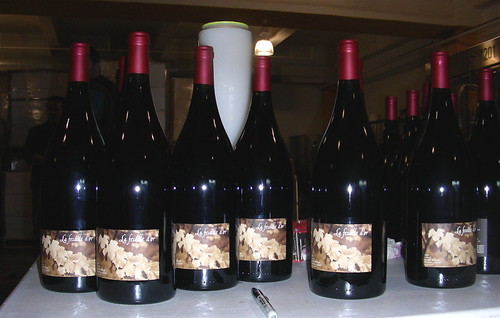
For the April meeting of his Wine Club, Arnaud wanted to tour the world with wines from not very well known wine regions. That evening, we tasted wines from places as different as Canada, Israel, Portugal, Lebanon, Greece, and Hungary, and made some exciting discoveries!

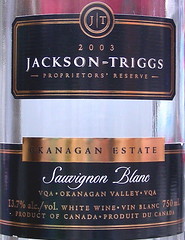
We started with Canada. Our first wine was a Okanagan Valley Sauvignon Blanc from Jackson-Triggs Vintners. The Okanagan Valley is British Columbia's oldest and main grape-producing region. It lies east of the Cascade Mountain at the same latitude as the northern German and French vineyards, but thanks to dry and sunny conditions, it is not considered viticulturally a cool climate region. The Jackson-Triggs Okanagan Estate vineyards are situated in the south Okanagan Valley on moderately sloping terraces above Osoyoos Lake. The lake has a beneficial cooling effect that tempers daytime high temperatures during summer.

The 2003 Jackson-Triggs Proprietors' Reserve Sauvignon Blanc Okanagan Estate was one of the discovery of the evening. It had a light straw color and an appealing nose of citrus and lemon blossom. On the palate it was dry and crisp with a refreshing mouthfeel and an interesting brown sugar finish. This wine ended up being everybody's favorite.
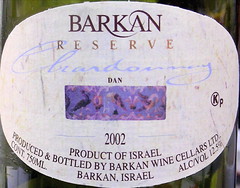
We moved to Israel with our next wine, a Chardonnay from Barkan Wine Cellars. Barkan Wine Cellars is one of the leading wine producers in Israel. With its new ultra-modern winery, it is enjoying an increasing popularity in its country as well as abroad.

The 2002 Barkan Reserve Chardonnay had a bright straw color and an intensely aromatic nose. The palate was soft with dairy and mineral flavors but I was somewhat disappointed by the short finish. Nevertheless, most of the guests enjoyed the wine for its minerality and aromatic character.
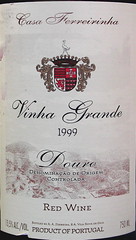
Our first red wine was from the Douro region of Portugal. Douro is maybe the world's most difficult wine region. Vineyards are planted on harsh and rugged mountains that rise up from the Douro River. There is almost no soil on these mountains and vines grow on hard shist and slate stones that retain little water and provide few nutrients. Temperature variations are often extreme. Protected from the humid Atlantic winds by four mountain ranges, the Douro enjoys hot, dry summers and very cold winters. Since the 18th century, the main product of the region is Port, but recently the quintas have been producing an increasing amount of high quality table wine.

The 1999 Casa Ferreirinha Vinha Grande Douro is a blend of the typical varietals that are used in Port. It had a dark color with black fruits and cocoa powder on the nose. On the palate, it was medium bodied with fine grain tannins and a well-balanced acidity on the finish. Many guests were not convinced by the wine although I personally liked it.
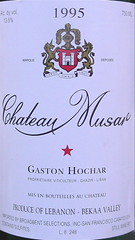
With our second red, the iconic Chateau Musar, we moved to Lebanon. Founded in 1930 by Gaston Hochar, Chateau Musar is located in an 18th Century castle in Ghazir, just fifteen miles north of Beirut. The vineyards lie 30 miles east of Ghazir in the Bekaa Valley. Chateau Musar is the winery's premium wine. It is a blend of Cabernet Sauvignon, Cinsaut, Carignan, Grenache and Mourvèdre. Each varietal is fermented separately in concrete vats and aged up to 24 months in French oak barriques. Then the final blend is made and the wine is bottled and stored in the Chateau's cellars until its release after about 5 years.

The 1995 Chateau Musar had a dark brick color and a gamey nose with notes of Provençal herbs. On the palate, it was medium-bodied and spicy with a long finish. The style of the wine was unusual and old-fashioned and many guests didn't like it.
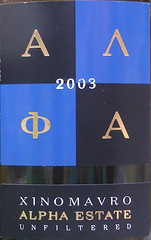
Then we moved to Greece with a Xynomavro from the Alpha Estate. The Alpha Estate is situated in the heart of the Amyndeon region in the far north west of Greece, towards the border of Albania. Xynomavro, which means sour black, is the principal red varietal of the region. It is a grape that produces wines with high level of tannins and acidity.

The 2003 Alpha Estate Xynomavro Unfiltered is a blend of Xynomavro, Syrah and Merlot. It had a deep purple color with aromas of cherry and vanilla on the nose. It was soft on the palate with a light finish.
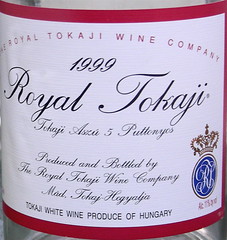
The first of our two dessert wines was a Tokaj Aszú from Hungary. Aszú is the Magyar word for noble rot. The wine was created in the seventeenth century in the Tokaj-Hegyalja region, perhaps by accident: an harvest been delayed because of war.

The shrivelled, raisiny, botrytis-infected berries are carefully picked by hand and put in puttonyos, traditional wooden vessels holding 20 liters. Then, a certain amount of the rich aszú paste (the more puttonyos, the sweeter and richer the wine) is added to a base wine, made the previous year from unaffected grapes. Furmint is the dominant varietal of the Tokaj region. Its thin skin makes it particularly susceptible to botrytis. Its name comes from the French word froment, or wheat for the wheat-yellow color of the wine it produces.

The 1999 Royal Tokaji Red Label Aszú 5 Puttonyos had a stunning bright apricot color and a vivid fruity nose. On the palate, the wine was fresh and lively, not sirupy at all. The mouthfeel was amazingly rich and light at the same time. I checked the alcohol content: only 11%! The wine was absolutely delicious with dried apricots.
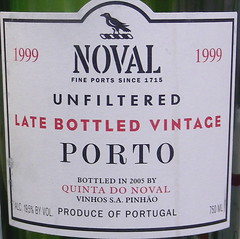
Our last wine took us back to the Douro region. To end this enlightening world tour, Arnaud had selected a Late Bottled Vintage Port from Quinta do Noval. Founded in 1715, Quinta do Noval is famous for its Nacional Vintage Port made from grapes grown on a small 2.5 hectare parcel of ungrafted vines.

Late Bottled Vintage (LBV) port is the product of a single year's harvest even in lesser years that are not declared vintage year. LBV port is generally smoother and lighter-bodied than vintage port. It is aged longer in barrel to mature more quickly but doesn't usually age in bottle. It is intended to be ready to drink upon release.
The 1999 Quinta do Noval Late Bottled Vintage Port was thick, sweet, warm and smooth on the palate with rich chocolate flavors, but it seemed very alcoholic after the Tokaj (19.5%). Nevertheless, the wine was excellent with bits of the bittersweet chocolate that Arnaud had brought. And what a wonderful way to end one of the first sunny evening of the season! We had stayed all the time outdoors, tasting the wines in the warm evening sun, comfortably seated on the lawn of our friendly hosts Benoit and Anne.

Technorati tags:

Tuesday, April 25, 2006

A five star rating for a tasting chart

Recently, rating notes have generated a flurry of attention in the blogosphere. First, in a post called The Art of the Wine Review, Tom Wark at Fermentation expresses his admiration for the reviews of wine merchant Kermit Lynch:

“The wine is described well.” he says about one of the reviews, “I have a connection to the wine through culture and art, I have context, I clearly understand the individuality of the wine and I'm entertained just by reading the review. Oh, and I want to buy it.”

But then, in The Total Fantasy of Wine Ratings, Mark Fisher at Wine Sediments questions the validity of wine ratings and tasting notes:

“With a wine of that production level [200,000 cases],” he wonders, “it's a damn sure bet that no matter how much blending Falesco does, there is not ONE SINGLE DROP of wine in the two-millionth bottle that comes off the production line that has much of ANYTHING in common in terms of vineyard site, clonal selection, picking time, etc. to the FIRST bottle that came off that production line, and which, for the sake of argument, was the bottle reviewed by the Wine Spectator. So why in the world would we give any credence whatsoever to what the wine's score was in the Wine Spectator, or Parker, or Decanter, or (shudder) even Wine Sediments?”

Furthermore, in Do Ratings Rate?, Eric Asimov at The Pour shares his mixed feelings about ratings:

“First of all, they can be valuable to consumers” he says, “For $100 a bottle, or $40, or even $20, people want to increase the odds that they are going to like what they pay for, and that's why ratings are useful.” But then he adds: “Tasting notes are among the least useful of all consumer aids. They offer the illusion of description, but really tell you very little about a wine.”

I also have mixed feelings about wine ratings and tasting notes. Tasting notes are very personal and have therefore far less significance to other people. I have also noticed substantial bottle to bottle variations: some wines that I had greatly enjoyed one day had disappointed me later with another bottle. On the other hand, tasting notes and ratings can be really helpful when you don't know the wine. Some tasting notes just compel you to buy it.

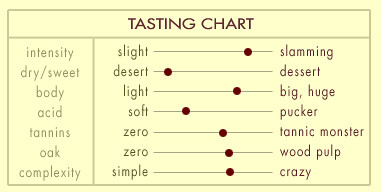
Now, while browsing the Tulip Hill Winery website, I recently discovered a tasting chart that, I think, is great at assessing wine quality and style. For instance, here is the tasting chart for the 2001 Tulip Hill Cabernet Sauvignon Napa Valley:


In addition to the chart, the winery also provides the following tasting notes: “A big wine, with dense blackberry, licorice and tobacco aromas, adding damp earth and violets to produce a rich yet delicate nose. Complex flavors of dark cherry, raspberry, cigar box, and dried fennel blend nicely with the toasty oak. Velvety tannins give exquisite texture and body, and a finish which borders on endless.”

So which do you think is more instructive? I would love to see these charts on shelf takers and also on restaurant wine lists. Isn't pairing a wine with food highly dependent on whether this wine is sweet, dry, acid and/or tannic?

Technorati tags:

Friday, April 21, 2006

Last tasting in Carmel Valley: the wines of Joullian Vineyards

Perched at 1400 feet in elevation in the Cochagua Valley, the 40 acres Joullian estate vineyard is planted with high density-spaced vines on a rocky loam soil. The most planted variety is Cabernet Sauvignon, followed by Zinfandel — Dick Sias, cofounder of Joullian Vineyards, is considered the father of Zinfandel in Carmel Valley —, Merlot, Sauvignon Blanc, Cabernet Franc, Sémillon, Syrah, Primitivo, and a patch of Italian field blend made of Aleatico, Alicante Bouchet, Carignane, and Grenache.

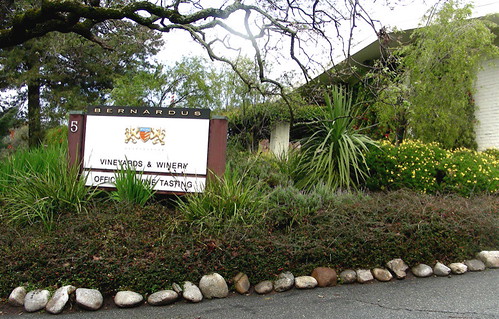
The winery is too remote to be visited but Joullian has a tasting room conveniently located in Carmel Valley Village, not very far from the Bernardus tasting room.

Tasting notes:

2004 Joullian Chardonnay Monterey County: sourced from Santa Lucia Highlands and Arroyo Seco vineyards. Ripe fruit aromas on the nose, buttery on the palate.

2004 Joullian Chardonnay Sleepy Hollow Vineyard: sourced from Talbott Vineyards' great Sleepy Hollow vineyard in the Santa Lucia Highlands appellation. Straw color, intense nose, complex and well-balanced on the palate, long finish, the best wine of the tasting.

2004 Joullian Chardonnay RogerRose Vineyard: from the Arroyo Seco appellation. Citrus aromas on the nose, crisp on the palate, finish not as lengthy.

Joullian Cépage Retro Rouge Carmel Valley: Non vintage. Blend of Cabernet Sauvignon, Zinfandel, Merlot and Syrah from the Carmel Valley appellation, Sweet candy nose, spicy Zin flavors on the palate, simple and easy.

2003 Joullian Family Reserve Merlot Carmel Valley: From the Joullian estate in Carmel Valley. Spicy nose, dry and somewhat tannic on the palate but lacks mid-palate concentration.

2002 Joullian Cabernet Sauvignon Carmel Valley: From the Joullian estate in Carmel Valley. Similar style as the Merlot. Also a bit hollow on mid-palate.

2003 Joullian Sias Cuvee Zinfandel Carmel Valley: From the Joullian estate in Carmel Valley, blend of Zinfandel, Petite Sirah, Aleatico, Alicante Bouchet, Carignane & Grenache. Intense fruity nose, a bit sweet with a lot of flavors on the palate, best red wine of the tasting.

2004 Joullian Zinfandel Rosé Carmel Valley: From the Joullian estate in Carmel Valley, blend of Zinfandel, Petite Sirah, Aleatico, Alicante Bouchet, Carignane & Grenache. Nice salmon color but really too sweet for my taste.

Well, after all these wines, we enjoyed a delicious and hearty meal at the nearby Café Rustica, before hitting the road and going back to the bay area.

Previous wines tasted in Carmel Valley:
• Talbott Vineyards
• Pelerin Wines
• Bernardus Winery

Technorati tags:

Tuesday, April 18, 2006

More from Carmel Valley: the wines of Bernardus Winery

On the second day of our trip to Carmel Valley, we visited the Bernardus tasting room.


Bernardus Pon is the owner of Bernardus Lodge & Winery. Born and raised in Holland, he moved to Carmel Valley with his wife Ingrid in the early nineties and bought a small winery there. Believing that the place could potentially make World class Bordeaux-style red wines, he created Marinus, a blend of primarily Cabernet Sauvignon with some Cabernet Franc, Merlot and Petit Verdot. Marinus is the winery's flagship wine with grapes coming from the Marinus Vineyard in the Carmel Valley appellation.

We actually had seen the Marinus vineyard earlier that day, as we were waiting for the tasting room to open. It was almost hidden among rolling hills, coast live oak woodlands, and horse ranches, at the end of a narrow and winding road in the remote and secluded Cachagua Valley. Todd Kenyon, who was born and raised on a adjoining ranch, manages the vineyard. He plants the vines with an average density three times what is typical in California and severely restricts irrigation during the growing season. Therefore, the vines are forced to perform under drought conditions and put all their energy into fruit development. They have smaller berries with more concentrated flavors.

Tasting notes:

2004 Bernardus Sauvignon Blanc Monterey County: 35 % is cool fermented in stainless steel tanks for freshness. Blended with 1% Sémillon. Pale yellow color, aromatic nose of citrus. On the palate, fresh, crisp and grassy. Great Summer wine.

2004 Bernardus Sauvignon Blanc Griva Vineyard: The Griva vineyard is located in a cool, windswept area of the Arroyo Seco appellation. Pale yellow color, citrus nose, more spices on the palate.

2003 Bernardus Chardonnay Monterey County: Light straw color, crisp, fresh, fruity style.

2001 Bernardus Chardonnay Griva Vineyard: Golden color, more intense nose, buttery and nutty on the palate.

2004 Bernardus Pinot Noir Monterey County: Purple color, sweet nose, fresh and peppery on the palate.

2001 Bernardus Pinot Noir Bien Nacido Vineyard: From the Santa Maria Valley appellation. Light ruby color, shy nose, some acidity on the palate, mature.

2003 Bernardus Pinot Noir Rosella's Vineyard: From the Santa Lucia Highlands appellation. Aromatic nose of cherry and vanilla. Rich flavors on the palate, intense finish.

2001 Bernardus Marinus Carmel Valley: Dark purple color, nice nose of blackcurrant, young and fruit-forward on the palate with some acidity on the finish.

1996 Bernardus Marinus Carmel Valley: The nose of a mature Bordeaux. Elegant and well balanced. Excellent.

1999 Bernardus Marinus Carmel Valley: In September 1999, just before the harvest, a devastating fire burned acres of local trees, and for sure, this wine is smoky!

Previously tasted:

• Talbott Vineyards

• Pelerin Wines

Technorati tags:

Sunday, April 16, 2006

Wednesday, April 12, 2006

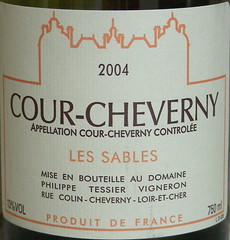
WBW #20: Cour-Cheverny, King Francis the First and Tintin

What is the relationship between Cour-Cheverny, an obscure appellation in the Loire Valley, Francis the First, France's first Renaissance monarch, and Tintin, the Belgian young reporter? You'll see, it's easy!

From the city of Blois in the Loire Valley, if you drive 15 km southeast, you'll find the Château de Cheverny. The castle is famous for being Hergé's model for Moulinsart, the ancestral home of Captain Haddock.


The castle is in the town of Cour-Cheverny, which gave its name to the Cour-Cheverny appellation, an appellation that was created for wines made exclusively from the Romorantin varietal. In fact, Cour-Cheverny is the only appellation in the world that uses Romorantin. According to legend, this rare Burgundian grape was brought by King Francis the First to the region on his way back from Italy in 1519.

Philippe Tessier is one of the few producers that grow Romorantin today. Its Cour-Cheverny cuvée Les Sables is made from old vines planted on light, sandy soil. To keep it bright and fresh, it is fermented in large neutral barrels and does not go through malolactic fermentation. The 2004 Cour-Cheverny Domaine Philippe Tessier Les Sables has a bright straw color and a fresh nose of lemon and grapefruit. On the palate, it is mineral with a snappy acidity balanced by mild nutty flavors. The finish is crisp and citrussy.

I will not claim that Romorantin is as noble a grape as its neighbor Chenin Blanc, but what a refreshing alternative to these far too often boring white wines that you find in the same price range. So let's not forget this unique varietal!

Today was April's Wine Blogging Wednesday and the theme proposed by Bill at Wine for Newbies was single-varietal white wines, but no Riesling, Sauvignon Blanc or Chardonnay. He has already posted a first roundup. Check it here.


Technorati tags:

Saturday, April 08, 2006

Barrel Tasting at Pelerin Wines

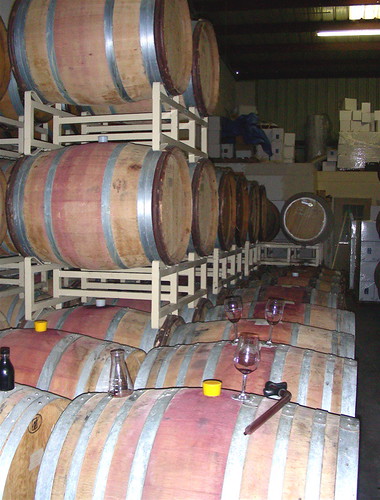
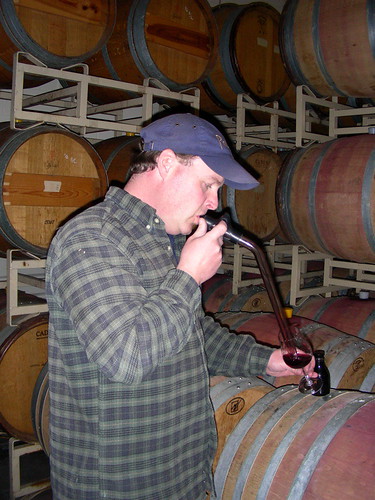
After tasting the wines of Talbott Vineyards, my friend and I took the scenic Los Laureles Grade and then Highway 68 to Salinas. We had an appointment with Chris Weiddemann, owner and winemaker of Pelerin Wines, in one of Salinas's industrial parks where he currently shares a space with another winery. We had really enjoyed his 2003 Pelerin Pinot Noir Rosella's Vineyard Santa Lucia Highlands and we were eager to try some of his new wines.

The name Pelerin means pilgrim in French and reflects Chris' ultimate quest for balanced and complex wines. While working for other wineries, Chris was able to forge relationships with some of the best grape growers in Monterey County and purchase grapes from Rosella Vineyard and Paraiso Vineyards, both in the Santa Lucia Highlands, and more recently, from Mesa del Sol Vineyard in the Arroyo Seco appellation. His first vintage was released in 2002.

Rosella Vineyard is a 50 acres east-southeast facing vineyard in the Santa Lucia Highlands. Thanks to the soil made of gravelly loam, and the cool climate (foggy mornings, sunny mid-days, windy afternoons), it is a place where Pinot Noir is thriving. The vineyard is owned by Gary Franscioni, also co-owner of the close by Garys' Vineyard, who named it after his wife Rosella.

Paraiso Vineyards is a 400-acre property located at the southern end of the Santa Lucia Highlands appellation. The land is owned by the Paraiso Vineyards winery, which sells part of its production to other wine producers.

Mesa del Sol Vineyard is a small organically farmed vineyard located in the Arroyo Seco river canyon, south of the Santa Lucia Highlands appellation. The site is warmer than in the Santa Lucia Highlands and a great place to grow heat-loving varietals such as Syrah, Primitivo and Sangiovese.

Chris is doing well and has plans to grow and move to a new facility at Paraiso Vineyards where he works part-time. He is also very happy with his Rhone-style wines, the quality of the grapes he gets from the Mesa del Sol Vineyard, and plans to make some Roussanne and Viognier in the near future.


Tasting notes:

2005 Pelerin Rosé (from barrel): fresh and very fruity

2005 Pelerin Pinot Noir Rosella's Vineyard (from barrel): a lot of structure, complex aromas, very promising

2005 Pelerin Pinot Noir Santa Lucia Highlands (from barrel): tasty but a lighter version of the Rosella's Vineyard

2005 Pelerin Syrah/Viognier blend (from barrel): powerful flavors of mint and pepper.

2005 Pelerin Syrah Monterey County (from barrel): very fruity, nice to drink already
2005 Pelerin Syrah Mesa del Sol Vineyard (from barrel): has tannins, structure, and complexity, my favorite with the Pinot Noir Rosella's Vineyard.

Technorati tags:

Tuesday, April 04, 2006

The wines of Talbott Vineyards

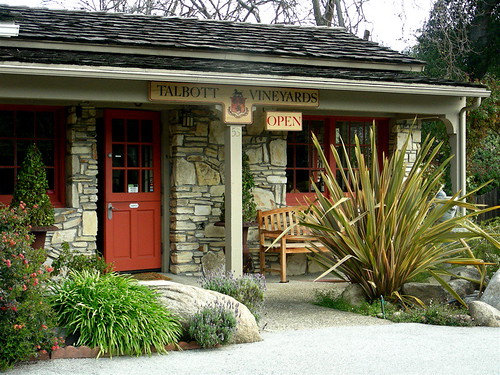
Talbott Vineyards was the first tasting room that I visited during my 2-day trip to Carmel Valley.


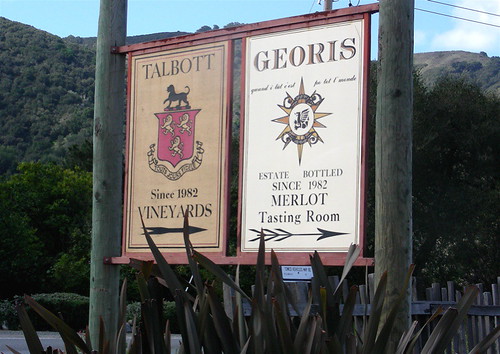
The story of Talbott Vineyards begins in 1950 when Robert Talbott Sr., his wife Audrey, and his son Robb moved to Carmel, California where they started a tie company. Eventually, the Talbotts became leaders in the luxury tie business as well as increasingly passionate about wines. In 1982, Robert Talbott and his son Robb founded Robert Talbott Vineyards and started planting Chardonnay on the 24-acre Diamond T Estate vineyard near their home in Carmel Valley, 8 miles from Carmel Bay.

The Diamond T Estate vineyard is planted with tightly spaced Chardonnay vines in almost soilless conditions of shale and granite on a 1,200 foot mountaintop. Due to challenging growing conditions, crop yields are extremely small and maritime influence as well as elevation leads to an extended growing season.

In 1994, the Talbotts bought the Sleepy Hollow Vineyard in the middle of the Santa Lucia Highlands appellation, along the western edge of the Salinas Valley. This hilly, 450-acre vineyard has a gravelly loam soil with a high percentage of gravel and rocks. It is a cool growing site with a predominately east-northeast exposure. Sleepy Hollow is planted in both Pinot Noir and Chardonnay. It also contains 12 acres of newer Syrah plantings.

Talbott is a family winery with both Robb and his wife Cynthia Talbott directly involved with winery management and operations. Many of their wines are named after family members.

Tasting notes:

2004 Kali Hart Vineyard Chardonnay: named after Robb and Cynthia's youngest daughter, Kali Hart. Made from purchased grapes grown in Monterey County. 80% is aged in neutral French oak, the rest in stainless steel. Light yellow color and a fruity nose of green apples. On the palate, lively acidity and a great freshness.

2004 Logan Chardonnay: named after Robb and Cynthia's son, Robert Logan. Produced from Talbott's Sleepy Hollow Estate Vineyard, it is 85% barrel fermented and aged in neutral French oak for 10 months. Creamy nose, ripe flavors of pear and pineapple on the palate, and a fat mouthfeel.

2002 Talbott Chardonnay Sleepy Hollow Vineyard: Produced from older vines from the Sleepy Hollow Vineyard. 100% barrel fermented in French Oak and aged on the yeast lees. Smoky nose, full-bodied on the palate with stone fruit flavors, well-balanced with some nice acidity on the finish.

2002 Talbott Chardonnay Cuvée Cynthia: Same as the Talbott Chardonnay but bottled without fining nor filtration. Butterscotch and apple flavors, rounder on the palate, many more acidity on the finish.

2001 Talbott Chardonnay Diamond-T Estate: From the Diamond-T vineyard. Deep golden color. Intense nose of pineapple, creamy flavors of baked flan on the palate, long finish.

2002 Talbott Chardonnay Cuvée Audrey: named for Audrey Talbott, Robb Talbott's mother. Also from the Diamond-T vineyard but bottled without fining nor filtration. Deep golden color, intense nose of tropical fruits, has many more acidity and a longer finish.

2001 Logan Pinot Noir: From the Sleepy Hollow Vineyard. Medium-bodied and soft on the palate. Easy to drink but seems to become oxidized after some time in the glass.
2000 Case Pinot Noir: named after Robb and Cynthia's oldest daughter, Sarah Case. From the Sleepy Hollow Vineyard. Aged in French oak. Nose of vanilla and red fruit. On the palate, smoky, earthy with a lengthy finish. Very tasty.

Technorati tags:

Sunday, April 02, 2006

A trip to Carmel Valley

Who has heard of the Carmel Valley appellation? Until two weeks ago, I believed that this narrow valley that takes you deep into the lush forests of the Santa Lucia Mountains, was just a picture-perfect setting for elegant weddings and anniversary celebrations. It is actually one of the oldest American Viticultural Area in California (colored in light pink on the map).
Few vineyards can be spotted from the road that follows the Carmel river and takes you to Carmel Valley Village, about 12 miles from the mouth of the valley. Although the size of the appellation is over 19,000 acres, less than 300 acres is under vine. The rest is a pastoral scenery of oak woodlands, grasslands, and chaparral. The primary grape growing area follows the Carmel River as well as the adjacent Cachagua Valley (an Indian derivative of the French cacher and Spanish agua that means hidden springs). With some parts of the valley enjoying more than 300 sunny days a year, it is warmer than the close by Santa Lucia Highlands appellation and is suitable for growing Bordeaux varieties such as Cabernet Sauvignon, Merlot and Cabernet Franc.

Because most of the wineries are in the upper part of the valley and can be difficult to reach, they have conveniently located their tasting rooms within a few steps of one another in the center of Carmel Valley Village. During my recent 2-day stay in the area, I was able to taste the wines of Talbott Vineyards, Bernardus Winery, Joullian Winery, and Pelerin Wines in Salinas.

Coming next: tasting the wines of Talbott Vineyards.


Technorati tags:

Tuesday, March 28, 2006

Rediscovering the wines from Pessac-Léognan and Graves

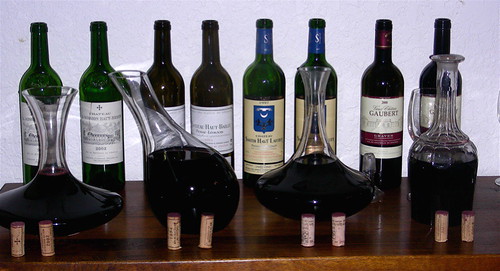
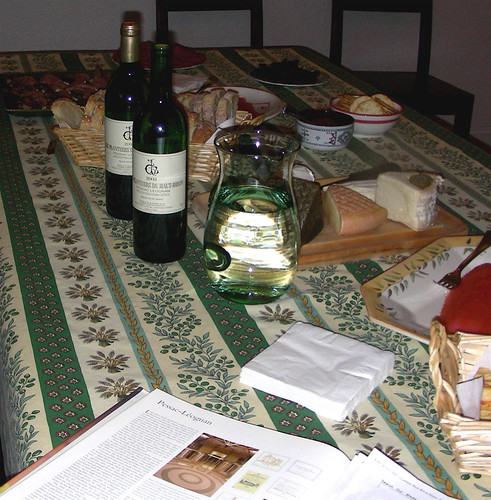
For some obscure reasons, the wines of Pessac-Léognan and Graves — with the exception of a few top estates — attract less prestige than the wines from other main regions in Bordeaux, such as the Médoc, Saint-Emilion or Pomerol. Therefore, Arnaud's last wine tasting event dedicated to the wines of Pessac-Léognan and Graves, was a great opportunity to rediscover the fine wines of this region.


Bordeaux Wine Office


The region has not always been out of fashion. In the Middle Ages, at a time when the Médoc was mainly marsh, moorland, and forests, Graves was renowned for its Claret, a light wine much enjoyed by the English and shipped in large quantities to England. Château Haut-Brion, Graves' most famous estate, was the first Bordeaux Château to achieve international recognition. Its 1784 vintage was one of Thomas Jefferson's favorite wines. In the 1855 classification, Château Haut-Brion was ranked First Growth along with Château Lafite-Rothschild, Château Latour, and Château Margaux. In 1959, Graves created its own classification system that recognized 13 Châteaux for their red wines and 8 Châteaux for their white wines.

Graves gets its name from the soil, a mix of gravels, clay and sand carried out by the river. The gravel pebbles work as thermoregulator: during the day, they reflect the sun and accumulate the heat that they radiate back to the vines at night. The soil is also very porous, which creates a semi-arid condition producing low-vigor vines.

It is the only region in Bordeaux that is renowned for both its red and white wines. Two third of Graves wines are red and made primarily from Cabernet-Sauvignon with smaller amounts of Merlot and Cabernet Franc. The white wines, generally fresh, fruity, and dry, are among the best white wines in Bordeaux. Usually vinified in oak, they are produced from three grape varieties, Sauvignon Blanc, Sémillon, and Muscadelle.

Tasting the white wines

Our first wine was the 2003 Les Plantiers du Haut-Brion. A blend of Sauvignon Blanc and Sémillon, this is the second white label of Château Haut-Brion. The wine was delicious and my favorite white wine. It had a pale yellow color and an attractive nose of pear, apple, and honey. On the palate, it had a fat mouthfeel with citrus and butterscotch flavors and a nice long finish.

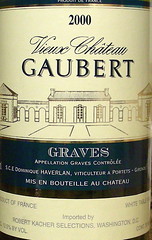
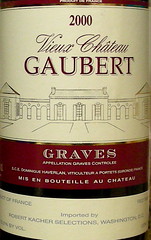
The next wine was the 2000 Vieux Château Gaubert Blanc. The Vieux Château Gaubert, from the Graves appellation, is considered to be a good value both in white and red. The white wine, a blend of 45% Sauvignon Blanc, 30% Sémillon, and 5% Muscadelle, had an aromatic nose of candied fruit, with grapefruit aromas on the palate. I found it to be crisper and leaner than the Plantiers du Haut-Brion.

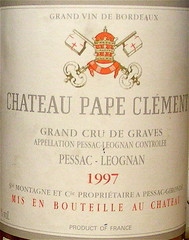
Our last white was the 1997 Château Pape Clément Blanc. Château Pape Clément is one of the most ancient estates in Bordeaux. One of its original owners, Bertrand de Goth, was elected Pope Clément V in 1305. He was the first of seven Popes to rule from Avignon. He was also the one that established the Pope's country residence and named it Châteauneuf-du-Pape. The white wine, a blend of 45% Sauvignon Blanc 45% Sémillon 10% Muscadelle, represents only 10% of the total production. Unfortunately, the wine that we tasted was oxidized. It displayed a pretty amber color but on the nose, it had unpleasant cheesy and sherry-like aromas.

Tasting the red wines


Our first red wine was the 2000 Vieux Château Gaubert Rouge, a blend of Cabernet Sauvignon, Merlot, and Cabernet Franc. I found the wine very pleasant with a red fruit nose, peppery aromas, a smooth palate and a well-balanced finish.

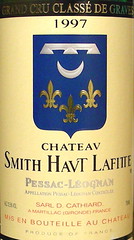
The next wine was the 1997 Château Smith Haut Lafitte. The vineyard of Château Smith Haut Lafitte is planted with 55% Cabernet Sauvignon, 35% Merlot, 10% Cabernet Franc for the red wine, a classified growth in the Graves classification, and 95% Sauvignon Blanc, 5% Sémillon for the white wine. I really enjoyed this wine, which was my favorite red wine. The nose was full of dark fruits, chocolate and coffee. On the palate, it was full-bodied and tasty with a long finish.

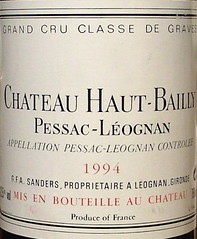
Then, we tasted the 1994 Château Haut-Bailly. The Château Haut-Bailly, another classified growth and one of the few properties that cultivates red varietals only. The Haut-Bailly vineyard consists of 65% Cabernet Sauvignon, 25% Merlot, 10% Cabernet Franc, and finally 15% still planted with vines on pre-phylloxera French rootstock. This means that there are still many plants of Carmenère, Malbec and Petit Verdot in the vineyard, as it was common in Bordeaux in the 19th century. The wine had a red fruit nose, nice cocoa powder flavors, and a lighter-bodied palate than the Smith Haut Lafitte. For many guests, this was their favorite red wine.

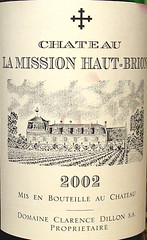
We finished the tasting with the 2002 Château La Mission Haut-Brion. The Château La Mission Haut-Brion property is planted with 48% Cabernet Sauvignon, 45% Merlot and 7% Cabernet Franc and lies on the opposite side of the road from Haut-Brion. For several decades, La Mission had been Haut-Brion's direct rival until the Dillon family of Haut-Brion acquired the property in 1983. Compared with Haut-Brion, La Mission tends to produce bigger and richer wines. The 2002 that we tasted was powerful indeed with smoky and chocolate aromas on the nose. It had a young and tannic palate with notes of crème brulée, followed by a vivid, lengthy finish.

Many thanks to Arnaud for another great tasting and to Marie-Christine and Edouard for sharing their house!


Technorati tags:

Thursday, March 23, 2006

Pinot Blanc, not always a poor man's Chardonnay

What is Pinot blanc? It is thought to be a white mutation of Pinot Gris, which is itself a lighter colored mutation of Pinot Noir. Originated in Burgundy, most of the Pinot Blanc that is grown in France nowadays is found in Alsace where it is one of the most widely planted varietals. For a long time, the grape has been confused with Chardonnay as the two varietals look similar. Often referred as poor's man Chardonnay, Pinot Blanc has the reputation to be rather neutral in flavor with a high acidity, but at its best, it can produce full-bodied wines with distinctive flavors.

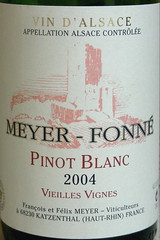
Take for example the 2004 Meyer-Fonné Pinot Blanc Vieilles Vignes. It is produced by the Domaine Meyer-Fonné of Katzenthal, a small wine village just 6 miles west of the main city of Colmar, on the Route des Vins d'Alsace. The wine was made from old Pinot Blanc vines, planted on a small lot of less than 3 hectares. It shows a pale yellow color and a floral nose with mineral aromas. On the palate, it is dry with a generous mouthfeel, honeyed apple flavors, notes of spices, followed by a clean, lively finish.

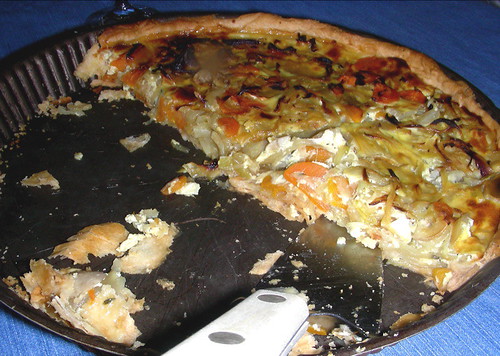
I like to serve this wine as a aperitif, and last night, it was delicious as usual. It went particularly well with my sweet onion tart, an adaptation of the Alsatian onion tart where I substitute bacon with carrots and mushrooms.


Technorati tags:

Monday, March 20, 2006

Mia's Playground Merlot

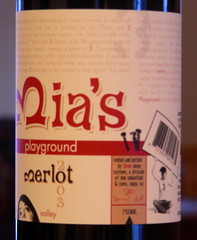
At a recent visit to my local Safeway wine aisle, I was surprised by all the new animal brands or fun brands with wacky names and catchy labels that you see on display now. One of them got my attention: the 2003 Mia's Playground Merlot Dry Creek Valley.

1. First, you read the label. The beginning is somewhat mystical:

“3's a well balanced number often representing a mystical trinity in which all things are contained in one, and one is present in all.”

But if you read the whole thing, you'll notice that there are three monkeys in a barrel and that the M in Mia's Playground is actually a 3. Three is obviously the magic number here, a reference to the three Sebastiani family members working for the Don Sebastiani & Sons company. Mia's Playground is actually named for Don's daughter, Mia (a three-letter name).

2. Then, you open the bottle. It's easy, the closure is a screw cap, like all the wines bottled by Three Loose Screws.

3. Finally, you taste the wine. “Drink this bottle with 2 other friends, making a party of 3.” says the label but we were only 2 last night. The wine had a dark color and an attractive nose of sweet blackberries. On the palate, it was medium-bodied and soft with a rather short finish.
But if you're looking for a fruit-forward, uncomplicated wine, this one is actually a well-crafted wine.

Technorati tags:

Thursday, March 16, 2006

Cleavage Creek: just a wine for macho winos?

No, this picture is not an Ad for one of these sexy Victoria Secret tops. This is a wine label from Cleavage Creek Cellars, a winery owned by Jeff and Barbara Conners of Sonoma County, California. The couple had been home winemakers for many years until 2003 when they decided to start their own wine business.

I learned about this winery in one of Dr Vino's recent posts. And then I read that the label might be in violation of the Wine Institute's voluntary Code of Advertising Standards. The label was considered to be degrading to women and tacky.

“We wanted a label that was eye-catching and would stand out. If you look at wine labels from 20 feet away, they all kind of blend together on the shelf.” explained Jeff Conners, one of the winery owners, to the Wines & Vines publication, “We found a way we can help fund breast cancer research with a fun name, a fun look and an award-winning wine.”

In 1999, Jeff and Barbara Conners learned that Barbara's grandmother developed breast cancer. Thanks to early detection and modern technology, she is now a breast cancer survivor, but breast cancer could be hereditary and someday affect Barbara or her daughters. Therefore, the winery donates 10% of its proceeds to Breast Cancer Research.

The Conners purchase wine from wineries in Northern California. Then the juice is blended and bottled at Cleavage Creek. Their Merlot, Cabernet Sauvignon and Chardonnay come from Napa Valley grapes, their Sauvignon blanc is from Mendocino County, and their White Zinfandel is a California appellation. Four of the winery's five wines won medals at the 2004 San Francisco Chronicle Wine Competition.

So, is the wine any good? I decided to buy some and donate to breast cancer research at the same time.

The 2002 Cleavage Creek Sauvignon Blanc Mendocino County has a blond model with a white top on its label. it has a light straw color and citrus aromas on the nose. The palate is light-bodied with grapefruit and lime flavors and high acidity. This is a very crisp wine that needs to be paired with a lemony dish.

With a pink ribbon on the label, the 2003 Cleavage Creek Catherine's Blend was created to honor Barbara's Grandmother. The wine is a blend of different Bordeaux varietals from diverse regions of California. it has a deep red/purple color and a nose of sweet fruit. On the palate, it is light to medium-bodied, with red fruits and mint flavors, followed by an acidic finish. Try this unsophisticated wine with a pizza or with spaghetti and meatballs.

The 2000 Cleavage Creek Cabernet Sauvignon Napa Valley has a blond model with a red top on its label. It has a deep garnet color and a more complex nose with blackcurrant and spicy aromas. On the palate, it is smooth, medium-bodied with a balanced finish.

After tasting these wines, I think that they are overpriced, even if 10% of the proceeds is donated to Breast Cancer Research. But the winery's website encourages you to join the Cleavage Creek Clinkage Club: as a member, you will have the privilege to access the photographs of prospective models and help selecting the ones for the new 2006 labels!
Technorati tags:

Sunday, March 12, 2006

A taste of Israel

Yesterday, a friend of mine brought a Israeli wine for dinner. I had never tasted a wine from that country before and I was curious to see what it would taste like. While not so long ago, most of the wines produced in Israel were reputed to be thick, sweet and unsophisticated, I am reading that today, the wine scene is booming with an increasing number of new quality-focused wineries.

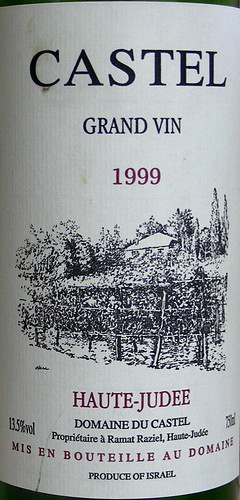
The wine was from Domaine Castel. It is a winery located in the Judean Hills, west of Jerusalem, and named after a nearby Crusader fortress. The estate vineyards are situated at an average altitude of 700m on slopes facing the Mediterranean sea and deep valleys enjoying cooler summer temperatures and shorter hours of sunshine. The premium red wine of the Domaine is the Castel Grand Vin, a Bordeaux blend of Cabernet Sauvignon, Merlot, and Petit Verdot. It is aged for 24 months in 100% new French oak barrels, as well as unfined and unfiltered. The winery also produces a Chardonnay and another Bordeaux blend called Petit Castel.

Last night, we drank the 1999 Domaine du Castel Castel Grand Vin with braised lamb shanks. The wine exhibited a dark purple color and opulent aromas of black fruits. On the palate, it was ripe and full-bodied with spicy dried fruit flavors on the finish. It went really well with the rich flavors of the lamb.

I love discovering new wines, especially when they are good, and for me, this wine compared very favorably to many Cabernet Sauvignon blends from better known wine regions of the world.

Technorati tags:

Wednesday, March 08, 2006

WBW #19: the true taste of Counoise

I can't believe we're already in March and today is Wine Blogging Wednesday. This month, the event is hosted by Jathan at Wine Expression, and the theme is When in Rhone.

I love the rich flavors of the Syrah-based and Grenache-based wines whether they come from the Rhône Valley, Spain, California or Australia. But what about the lesser known varietals that also thrive in the Rhône Valley and other wine regions with a similar climate? What about Counoise for example?

Counoise is one of the thirteen authorized grape varieties of Châteauneuf-du-Pape. Although rarely used nowadays, it was well established in the Rhône Valley in the late 19th century. At that time, Joseph Ducos, who was the owner of Château La Nerthe and the first French grower to import rootstock to overcome the phylloxera epidemic, had selected Counoise as one of the ten grape varieties that he would grow in his vineyard, because of “its personality, charm, freshness, and bouquet”. The origin of the grape is unknown but the Provencal poet Frédéric Mistral, who was also an accomplished gourmet, claimed that “the Counoise grape variety was a gift from Spain to Pope Urbain V”.

Today, Château de Beaucastel is one of the rare domains that use Counoise for its Châteauneuf-du-Pape wine. It typically includes 10% of Counoise to the blend to add peppery notes and lively acidity. In 1990, Tablas Creek Vineyard imported some Counoise cuttings from Château de Beaucastel and the winery started planting the varietal in the Paso Robles Hills. Since 1999, Counoise usually comprises 5-10% of Tablas Creek's Esprit de Beaucastel.

Counoise is a blending component allowed in most of the South of France appellations but it is almost never used on its own. So how can we identify the true flavor of Counoise?

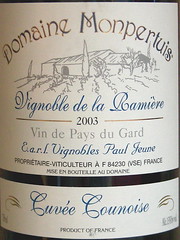
Fortunately, I was able to find two 100% Counoise wines at my local K&L Wine Merchants store. One of them was the 2003 Domaine Monpertuis Vignoble de la Ramière Cuvée Counoise. Paul Jeune, owner of Domaine Monpertuis, produces wines in red and white color in the Châteauneuf-du-Pape appellation. He also makes this Vin de Pays du Gard from a small parcel of vines that he recently acquired in the Gard region, just across the Rhône River from Châteauneuf. The vineyard, called Vignoble de la Ramière, is planted with Counoise and Grenache. This wine is a 100% Counoise cuvée. It had a deep garnet-red color and a discreet nose of pepper and black fruits. On the palate, it was rich, spicy and mouthfilling with a lively acidity on the finish.

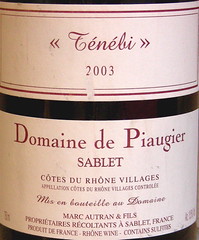
The other wine was the 2003 Côtes du Rhône-Villages Sablet Domaine de Piaugier Ténébi. Domaine de Piaugier is, according to Robert Parker, the emerging star of Sablet. Jean-Marc Autran, the domaine owner, discovered Counoise while visiting Beaucastel: “In 1990, I visited Beaucastel and I tasted their Counoise in barrels and I thought that was extraordinary and since I had some planted and had time to kill. In 1991, I decided to bottle the Ténébi and it turned out even better than I thought it would”. The wine had a dark garnet color and a intense nose of red and black fruits. On the palate, it was dense and peppery with pruny flavors, followed by a long finish.

The two wines were very good indeed although I preferred the Domaine Monpertuis because it was softer and more food-friendly.

So would now be the time for Counoise to get out of obscurity?.

Technorati tags:

Tuesday, March 07, 2006

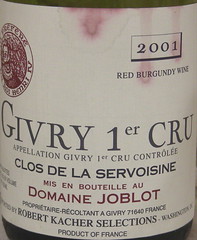
2001 Givry Premier Cru Clos de la Servoisine Domaine Joblot

Givry is a small village in Burgundy and one of the best appellations of the Côte Chalonnaise. It used to be famous as the preferred wine of King Henri IV but later suffered a decline following the destruction of the vineyard by phylloxera and two World Wars. Today, Givry offers some of the best values in Burgundy.

I don't know the origin of the word Servoisine but for me it rhymes with Framboisine, a dessert made with raspberries. So I was not surprised when, as I was opening the 2001 Givry Premier Cru Clos de la Servoisine Domaine Joblot , I detected lovely raspberry liqueur aromas in the wine. In the glass, the wine had a medium ruby color and a perfumed nose of raspberry and blackcurrant. On the palate, it was smooth, smoky and fruity with some lively acidity. This wine was simply delicious with our braised short ribs.

Some people believe that the plants that grow next to a vineyard can contribute to the taste of the wine made from that vineyard. I will not be surprised to learn that they grow raspberries in the Clos de la Servoisine.

Technorati tags:

Friday, March 03, 2006

Pinot Noir Blind Tasting

Our wine tasting group met again last month for a Pinot Noir tasting. It is interesting to notice that the wines that people brought were all from California except one that was from Oregon (it was also the only one from the 2003 vintage). More surprisingly, they were all from wine regions north of San Francisco — no Sideways Pinot here.

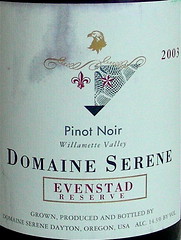
First, we tasted the 2003 Domaine Serene Pinot Noir Evenstad Reserve Willamette Valley. Located in Oregon's Northern Willamette Valley, Domaine Serene is a winery that utilizes environmentally responsible and sustainable farming practices. The wine, unfined and unfiltered, was aged 16 months in French oak barrels, of which 74% were new. It had a dark garnet color. The nose was discreet but pleasant. On the palate, it was fruity and tannic with some notes of brown sugar. Overall, some tasters found it young and irregular with some good potential while others found it fresh and well-balanced. It was ranked second in the tasting.

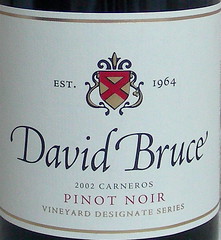
Our second wine was the 2002 David Bruce Pinot Noir Truchard Vineyard Los Carneros. Located in the cool Los Carneros appellation, the Truchard Vineyard has 270 acres planted with 10 different grape varieties on various types of soil: clay, shale, sandstone, volcanic rock and ash. The wine was the darkest of all. It had a powerful nose with sweet blackberry aromas. On the palate, it was big, chewy and oaky with a long finish, but some tasters found it too intense and alcoholic. It came in third place just one point behind the Domaine Serene.

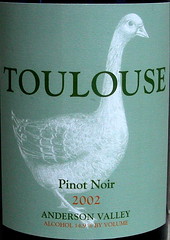
Our third Pinot was the Oak Arbour Pinot Noir Toulouse Vineyard Anderson Valley. Mendocino County's Anderson Valley is slowly emerging as one of California's best region for Pinot Noir. A mere 10-15 miles from the Pacific Ocean, the valley enjoys a cool, coastal climate with night and morning fog and warm summer days, which is ideal for Burgundian varieties like Pinot Noir and Chardonnay and classic Alsatian varieties like Riesling, Gewürztraminer, and Pinot Gris. This wine had a much lighter color than the David Bruce. It had also a lighter nose with floral and fruity aromas. On the palate, it was slightly sweet but elegant and well balanced. The group found it very food friendly and placed it in first position. This wine was my favorite too! There is a duck on the label so this makes me think about having a duck magret — one of the culinary traditions of Toulouse &mdash with the wine.

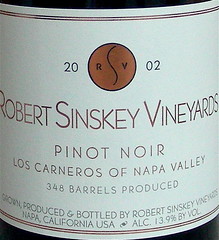
Our next wine was the 2002 Robert Sinskey Pinot Noir Los Carneros. Robert Sinskey Vineyards is a winery that strongly believes in organic farming, natural winemaking, and emphasizes elegance over power. The wine had a dark color and a shy fruity nose. On the palate, it was a bit flat and tart with a short finish. A few tasters favored it over the ones with a bigger style. I personally have to admit that this wine was more difficult to appreciate coming after the first three. The wine finished in fifth position.

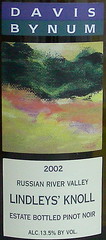
Then we tasted the 2002 Davis Bynum Pinot Noir Lindleys' Knoll Russian River Valley. The wine comes from a certified organic vineyard in the Russian River Valley, planted with 14 year-old vines on well-drained hillside soils. The wine was aged in French oak for 17 months, and 30% new oak was used. It had a pleasant aromatic nose with notes of strawberry. On the palate, it was tight, woody and acidic, leaving a short finish. The group found it too young and quite unbalanced and placed it in fifth position.

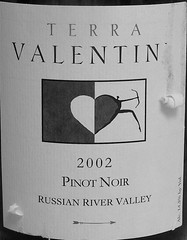
Our last wine was the 2002 Terra Valentine Pinot Noir Russian River Valley. The wine showed a lighter color and a discreet nose of citrus and grapefruit. On the palate, it was sweet, too sweet for many tasters, with flavors of vanillin oak leaving a somewhat bitter and acidic finish. The wine finished in fourth place just one point above the Davis Bynum and the Robert Sinskey.

Now, following the tradition that we started with our 1999 Cabernet Sauvignon blind tasting, we are saving a second bottle of these wines for a future tasting, and I am very curious to see how these wines will taste in one or two years!

Technorati tags:

Wednesday, March 01, 2006

Making our own wine: update 4 (bottling)

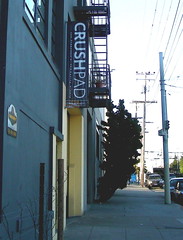
I am part of a group of twenty or so wine lovers who decided to make their own wine through the winemaking assistance and facilities of Crushpad, a community winery located in San Francisco. Crushpad allows you to choose your level of participation in the winemaking process and be involved in key decisions. Making a wine at Crushpad starts with selecting a vineyard and grape variety and then creating a winemaking plan with the Crushpad team that specifies the desired wine style as well as fermentation, aging, blending and bottling related parameters.

The first time I came to Crushpad was in October 2004. Our wine was in a fermentation vat. It was a Syrah from the Clary Ranch vineyard, a cool area located in the Sonoma Coast appellation. That day, we learned how to punch down the cap and measure the brix level of the fermenting juice. A week after, the fermentation was over and we came back to press the wine and transfer it into our Burgundy barrel.

Then, last April, I was able to taste the wine after nearly six months of barrel aging. The wine was promising with a firm backbone and nice fruity and peppery flavors.

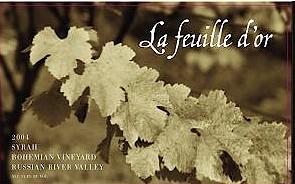
Finally, we came back to Crushpad last week for the last step. Our Syrah had been patiently aging for more than 15 months and was ready to be bottled. The Crushpad design team had already produced a label for the wine, based on a photo of the Clary Ranch vineyard taken by our friend Arnaud.


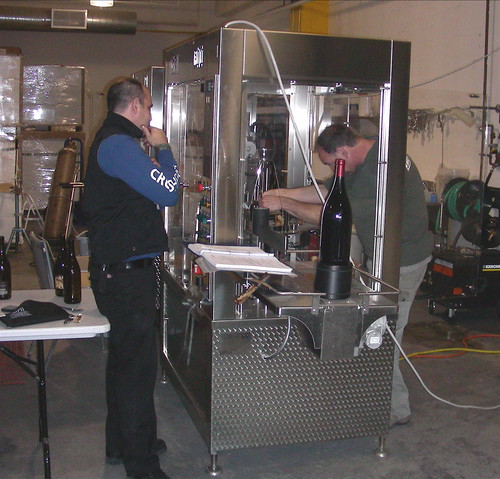
When I arrived, the Crushpad team was around an impressive bottling machine, making the last adjustments. For some reason, the labeling part was not functioning properly but the rest of the machine was working fine.


I was offered a taste of the wine. Since my last tasting of the Syrah, it had been blended with a dash (2.5%) of Viognier, in the Côte Rôtie style. The nose was very aromatic and appealing. On the palate, it was smooth and fruity with notes of vanillin oak. Overall, I found it very pleasant and easy to drink. According to the winemaker, this wine should rather be drunk young.

We quickly started the bottling process. Our barrel had a capacity of 228 liters, so we had to work on roughly 300 750ml-bottles, but in reality less because some people had also ordered some magnums.


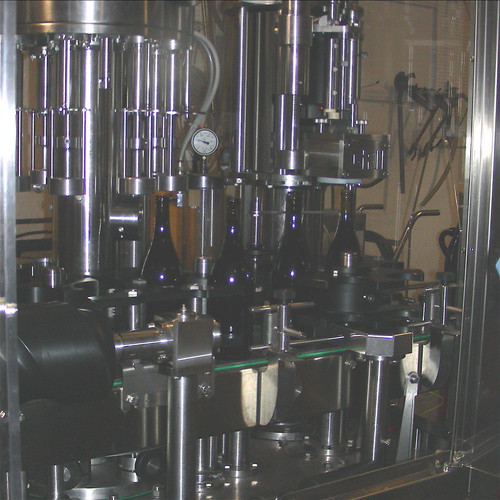
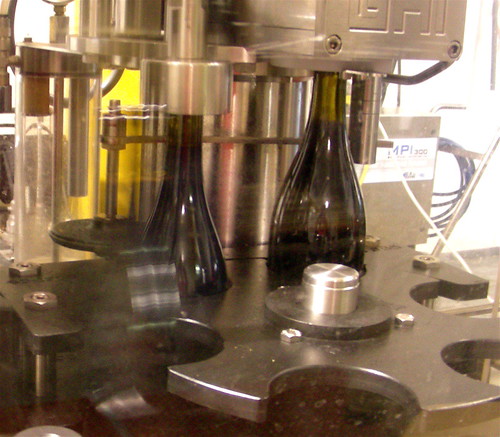
In a bottling machine, the wine is pumped from a storage tank to the machine where it flows in pre-measured amount into each bottle.


Then the bottles move to the corking area where a cork is inserted into each bottle. Finally, the bottles receive a piece of aluminum foil that is wrapped around their cork. At the exit of the bottling line, the bottles are ready to be labeled and put into boxes.


At the end, there was no wine left in the storage tank. All the bottles were in boxes waiting for us to be picked up. It was time to leave the friendly Crushpad team and allow the wine to rest. Now, stay tuned, we will taste the wine again in a year or so and see how it had evolved after some bottle aging.

Related stories:
• Making our own wine!
• Making our own wine: update 2
• Making our own wine: update 3


Technorati tags: